The Staggering Reality Behind Today’s Tech Billionaires
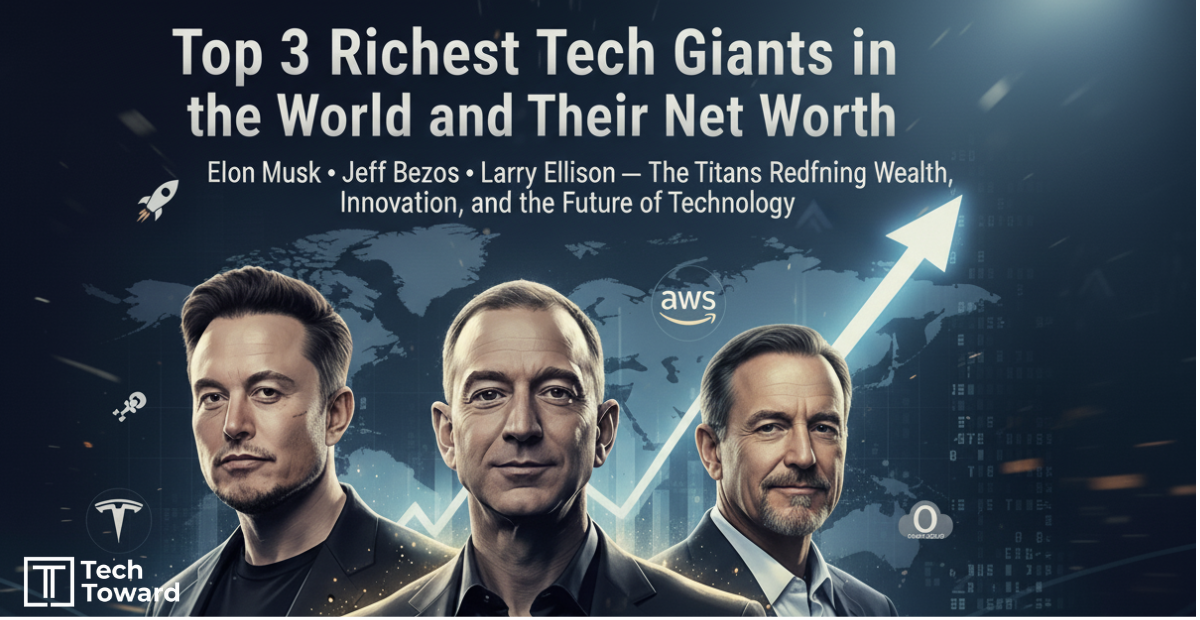
The race for the title of richest person alive isn’t just about wealth—it’s about innovation, ambition, and transformation. The world’s top tech billionaires have built empires that touch nearly every aspect of modern life, with personal fortunes surpassing the GDPs of many nations. Beneath those massive numbers lies a deeper story of bold ideas, extreme risk-taking, and an unrelenting pursuit of the future.
This deep dive explores how Elon Musk, Jeff Bezos, and Larry Ellison amassed and manage their extraordinary wealth—and what their success reveals about technology’s next frontier.
1. Elon Musk: The Maverick of Modern Capitalism
Net Worth: ~$430–450 billion
Elon Musk stands at the top of the billionaire mountain, his wealth driven mainly by Tesla and SpaceX. Yet, Musk’s story is far from linear. From selling Zip2 in the late 1990s to nearly going bankrupt funding Tesla, SpaceX, and SolarCity, his journey embodies high-stakes entrepreneurship.
Risk, Resilience, and Reinvention
After selling PayPal to eBay in 2002, Musk reinvested his entire fortune into three companies—an audacious move that nearly destroyed him. By 2008, all were close to collapse until a last-minute NASA contract and emergency Tesla funding saved him. That same risk-tolerance would later multiply his fortune hundreds of times over.
Tesla’s Meteoric Rise
Musk’s 2018 compensation package tied his earnings entirely to performance milestones that critics deemed “impossible.” He hit every target within three years, propelling Tesla’s valuation past $1 trillion and his personal wealth to record-breaking levels.
His stake in Tesla—combined with his ownership of SpaceX (valued over $150 billion)—makes him the most volatile billionaire in history. A single Tesla stock swing can move his net worth by $20 billion in a day.
The Broader Empire
Beyond cars and rockets, Musk’s ventures like Neuralink, The Boring Company, and X (formerly Twitter) push into AI, brain interfaces, and digital communication. While X’s valuation dipped post-acquisition, Musk envisions transforming it into an “everything app” integrating payments and services.
Why Musk’s Wealth Fluctuates
Because most of Musk’s net worth is tied to Tesla stock, it rises and falls with market sentiment. In 2022, he lost over $200 billion—only to recover much of it by 2024. His wealth, though unstable, symbolizes the scale of modern entrepreneurial risk and reward.
2. Jeff Bezos: The Architect of Long-Term Empire Building
Net Worth: ~$220–240 billion
Where Musk thrives on chaos, Jeff Bezos built his fortune on patience, discipline, and customer obsession. From Amazon’s humble start in a Seattle garage to becoming a global powerhouse, Bezos’s methodical approach redefined e-commerce and cloud computing.
The Amazon Foundation
Bezos launched Amazon in 1994 as an online bookstore. His parents invested their life savings, and for years, Amazon operated with minimal profits. Bezos prioritized growth and customer experience over earnings—an approach Wall Street initially mocked. Today, it’s the playbook for every ambitious startup.
AWS: The Real Profit Engine
While Amazon’s retail arm made it famous, Amazon Web Services (AWS) made Bezos ultra-rich. AWS, now generating over $90 billion in revenue, powers much of the modern internet. Its staggering profit margins transformed Amazon’s financial profile, proving that long-term vision trumps short-term gains.
Diversification and Blue Origin
After stepping down as Amazon’s CEO in 2021, Bezos diversified through Blue Origin, his private space company focused on space tourism and long-term off-Earth infrastructure. His other assets include a vast real estate empire and ownership of The Washington Post.
Bezos’s investments reflect a strategy of long-term influence—balancing profit, philanthropy, and legacy.
Divorce and Wealth Redistribution
Bezos’s 2019 divorce from MacKenzie Scott transferred around $36 billion in Amazon stock to her—one of history’s largest settlements. Yet, thanks to Amazon’s continued growth, both saw their fortunes expand afterward.
Looking Ahead
With Amazon dominating U.S. e-commerce and AWS leading cloud computing, Bezos remains positioned for future growth. His gradual shift toward philanthropy and space exploration hints that his next chapter may be more about impact than accumulation.
3. Larry Ellison: The Database King Turned Investment Powerhouse
Net Worth: ~$220–235 billion
While Musk and Bezos dominate headlines, Larry Ellison, Oracle’s co-founder and CTO, represents a quieter kind of dominance—consistent, calculated, and deeply entrenched in the enterprise tech world.
Oracle’s Foundations
Founded in 1977 with just $2,000, Oracle became the world’s dominant database company, powering global finance, telecommunications, and commerce. Ellison’s aggressive sales strategy and early insight into the importance of business software gave Oracle a durable competitive edge.
The Cloud Pivot
As cloud computing disrupted traditional enterprise software, Ellison steered Oracle into cloud infrastructure with Oracle Cloud Infrastructure (OCI). Today, OCI generates over $20 billion annually, keeping Oracle relevant in the AI and enterprise data race.
The Tesla Investment and Strategic Bets
In 2018, Ellison bought about $1 billion worth of Tesla stock and joined its board. That stake ballooned to over $15 billion, marking one of the most successful personal investments in corporate history.
His broader portfolio includes cutting-edge tech bets, luxury real estate, and even 98% ownership of the Hawaiian island of Lanai, which he’s turned into a sustainable living laboratory.
Read More: Larry Ellison Beats Elon Musk After Oracle’s $300B AI Deal
A Lifestyle of Power and Elegance
Ellison fully embraces his wealth—owning yachts, private jets, and mansions worldwide. Yet behind the opulence lies an unrelenting competitive spirit. Even in his 80s, Ellison remains Oracle’s driving force, blending business mastery with visionary investing.
Comparing the Titans: Musk vs. Bezos vs. Ellison
| Factor | Elon Musk | Jeff Bezos | Larry Ellison |
| Risk Profile | Maximum risk-taker; bets everything on moonshots | Long-term strategist; calculated patience | Aggressive but steady; profit-focused |
| Wealth Volatility | Wild swings tied to Tesla | Moderate due to Amazon stability | Low; driven by Oracle’s consistency |
| Diversification | Minimal; heavily Tesla/SpaceX | Extensive (Blue Origin, media, real estate) | Balanced investments and real estate |
| Public Persona | Highly visible and controversial | Controlled, strategic | Competitive yet discreet |
| Spending Habits | Focused on reinvestment | Strategic luxury and philanthropy | Lavish lifestyle and legacy projects |
Each billionaire’s approach reflects a unique philosophy: Musk’s chaos-driven innovation, Bezos’s long-term empire-building, and Ellison’s disciplined control. Yet all share five traits—vision, endurance, control, reinvestment, and bold risk tolerance.
Why Their Net Worths Swing So Dramatically
Their fortunes are largely on paper, tied to fluctuating stock prices:
- A 3% move in Tesla changes Musk’s wealth by roughly $13 billion.
- A 1% shift in Amazon alters Bezos’s net worth by about $2 billion.
- Oracle’s stability gives Ellison smaller, steadier movements.
Global factors—interest rates, inflation, and tech hype cycles—impact all three. A single AI announcement can move markets and billionaire rankings overnight.
Read also: White House Power Dinner: Big Tech CEOs Rally Around Trump
The Road Ahead: Who’s Poised to Stay on Top?
Elon Musk
If Tesla executes on full self-driving and humanoid robotics, Musk could become the first trillionaire. But his divided focus and market volatility remain significant risks. SpaceX’s Starlink expansion could add another massive revenue stream.
Jeff Bezos
With AWS dominating cloud computing and Amazon expanding into AI, healthcare, and advertising, Bezos’s wealth should grow steadily—even without daily management. His long-term investments in space and climate initiatives define his legacy.
Larry Ellison
Ellison’s steady Oracle ownership and strong cloud growth ensure stable compounding wealth. His diversification gives him insulation from tech market shocks and positions him as a long-term anchor in the billionaire rankings.
What These Fortunes Reveal About Modern Innovation
These billionaires didn’t inherit empires—they built them. Musk accelerated the world’s transition to sustainable energy and space exploration. Bezos reshaped global commerce and cloud computing. Ellison laid the digital foundations of enterprise software and data management.
Their extreme wealth mirrors their massive impact. Yet their stories highlight not greed, but vision turned into execution. They embody the modern formula for wealth creation: high risk, deep focus, and relentless reinvestment.
Key Lessons from Extreme Wealth Creation
- Think long-term: Decades, not quarters, determine true success.
- Concentrate first, diversify later: Focus builds wealth; diversification protects it.
- Reinvest relentlessly: Each billionaire plowed profits into the next big idea.
- Survive failure: Every one of them nearly lost everything—and kept going.
- Maintain control: Ownership enables bold decisions outsiders can’t make.
The Bottom Line
Together, Musk, Bezos, and Ellison control over $900 billion—more than most countries produce in a year. Yet their influence extends beyond balance sheets. They’re shaping the future of transportation, commerce, AI, and space.
Their stories aren’t just about money—they’re blueprints for ambition. Whether you’re building a startup or managing a career, their paths reveal timeless lessons: dream big, take calculated risks, and keep reinvesting in your vision until it transforms the world.
Frequently Asked Questions
1. Who is currently the richest tech billionaire in the world?
As of 2025, Elon Musk holds the top position with a net worth fluctuating around $430–450 billion, largely driven by his stakes in Tesla and SpaceX.
2. How did Jeff Bezos build his fortune?
Jeff Bezos founded Amazon in 1994 and grew it into the world’s largest e-commerce and cloud computing company. His wealth primarily comes from his remaining Amazon shares and his investments in Blue Origin and media ventures.
3. Why does Elon Musk’s wealth change so much?
Musk’s fortune is mostly tied to Tesla’s stock, which is highly volatile. A single day’s market movement can raise or lower his net worth by tens of billions of dollars.
4. What makes Larry Ellison’s wealth different from Musk and Bezos?
Unlike Musk or Bezos, Larry Ellison’s wealth comes from Oracle, a stable enterprise software company. His portfolio is more diversified and less exposed to market swings, though he’s also a savvy investor in Tesla and AI ventures.
5. Could any of these billionaires become a trillionaire?
Elon Musk has the best chance. If Tesla’s AI and autonomous driving programs scale successfully and SpaceX continues to grow, he could reach the trillion-dollar mark within the next decade.
6. What lessons can we learn from these tech giants?
Their stories show that building extreme wealth requires long-term vision, bold risk-taking, persistent reinvestment, and control over your ventures—principles that apply to entrepreneurs at any scale.
Conclusion
In short, the journeys of Elon Musk, Jeff Bezos and Larry Ellison offer more than billion-dollar net-worths—they demonstrate that extreme vision, unwavering persistence, concentrated risk, and timely diversification can turn bold ideas into global powerhouses.
Their stories teach us: vision + risk + reinvestment = legacy far beyond dollars.