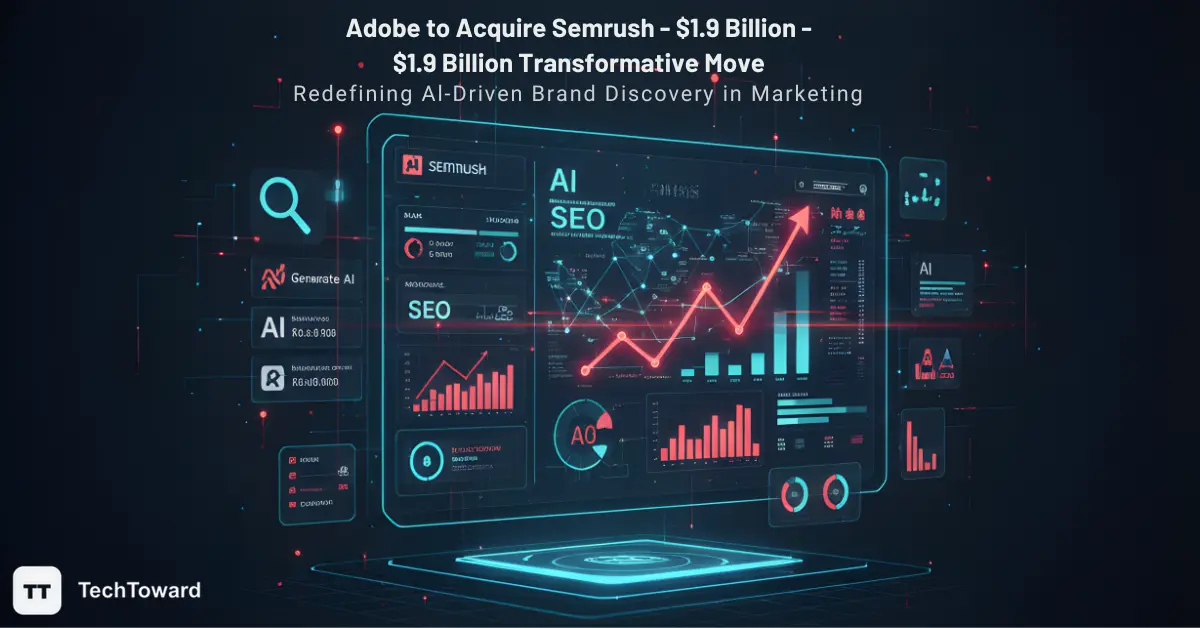
Adobe acquiring Digital Marketing Tool Semrush in just $1.9 Billion might sound like just another big tech M&A — but underneath lies a bold, transformative bet on the future of AI-powered search visibility. With this move, Adobe is not only buying an SEO company; it’s unlocking a new chapter in how brands will be discovered in a world shaped by generative AI — and for marketers who understand this shift, the opportunity could be enormous.
Why This Feels Different — and Why You Should Care
Imagine you’ve built a beautiful brand online. You’ve optimized every page for SEO, you run paid campaigns, and you’re continually tweaking your content for organic reach. But lately, you’re hearing that search is changing — not just because of Google’s algorithms, but because users are increasingly getting answers from AI. People are asking chatbots, not search engines, and your brand risks becoming invisible in those conversations.
That’s exactly what Adobe sees. Its decision to acquire Semrush for $1.9 billion isn’t just about bolstering its marketing tools — it’s about securing a place in the future of intelligence-driven brand discovery.
Here’s what you’ll learn in this article:
- Why Adobe made this move now
- What Semrush brings to the table (far beyond backlinks and keywords)
- How this could reshape marketing norms
- The risks involved — and what marketers need to do next
Why Adobe Is Pulling the Trigger on Semrush
A Strategic Bet on Generative AI and Brand Visibility
Adobe is making a forward-looking bet: the next frontier of brand discovery is not just search engines, but large language models (LLMs) and AI agents. As users increasingly rely on chatbots for information, brands need to be visible not just in Google results, but in AI-generated responses.
That’s where Semrush plays a critical role. Its expertise in SEO meets its growing strength in Generative Engine Optimization (GEO) — the practice of optimizing a brand’s presence for how it appears in AI-powered interfaces.
Closing a Gap in Adobe’s Stack
Adobe already has a powerful marketing and analytics stack — Experience Manager, Adobe Analytics, and its newer Brand Concierge. But what it lacked was deep, real-time intelligence into how brands are discovered across the web and in AI.
By integrating Semrush, Adobe can connect visibility data (from both human searches and AI agents) directly into its content and experience workflows. That means marketers could theoretically create content, test visibility, and optimize for search and AI — all within Adobe’s tools.
A Bold Financial and M&A Move
Adobe is paying $12 per share, valuing the deal at around $1.9 billion. The acquisition has already been approved by both companies’ boards, and the closing is expected in the first half of 2026, pending regulatory and shareholder approvals.
This is one of Adobe’s most significant purchases in recent years — signaling not just investment in AI, but a willingness to integrate data-centric, visibility-focused technology at scale.
What Semrush Actually Brings to Adobe — Beyond the Obvious
SEO + Data Powerhouse
Semrush is not just a keyword research tool. It’s a full visibility platform, covering SEO, competitive research, content insights, social, and paid media. Its strength lies in data depth: millions of keywords, a vast backlinks database, and sophisticated domain analytics.
But even more importantly now, Semrush has been developing GEO capabilities — tools that help brands optimize for AI-first discovery, not just web search. This makes Semrush a strategic partner for Adobe’s AI ambitions.
Trusted Enterprise Footprint
Semrush already serves big-name customers — Fortune-tier companies that rely on its data for high-stakes marketing decisions. Its enterprise segment has seen strong growth, making it especially attractive to Adobe, which commonly works with large clients.
This acquisition gives Adobe a bridge into the data intelligence world, complementing its creative and experience offerings with deep search and visibility analytics.
A Bridge to AI-First Marketing
In integrating Semrush, Adobe isn’t just acquiring SEO tools — it’s acquiring visibility intelligence for AI.
With Semrush’s data, Adobe can help brands understand:
- How they appear in LLM-driven answers
- Which AI-generated interfaces mention or reference them
- How to optimize content not just for search engines, but for generative AI
This serves as a bridge between content creation, experience orchestration, and brand discovery — all within a world where AI agents are increasingly part of the buyer journey.
Risks & Challenges: What Could Go Wrong
This is a big deal, but it’s not without its risks. Here are some to keep in mind:
- Regulatory Risk: The acquisition needs regulatory clearance and shareholder approval. These kinds of deals are scrutinized, especially with big tech and data-heavy targets.
- Integration Risk: Merging Semrush’s platform into Adobe’s existing tools is non-trivial. There’s a risk in aligning roadmaps, teams, and product philosophies.
- Customer Risk: Semrush’s existing users may worry about price increases or changes to the product. There could be churn.
- GEO Adoption Risk: While GEO is compelling, it’s still a relatively new concept. If adoption of AI-driven discovery doesn’t ramp up as expected, the value of this bet could be lower.
- Competition & Market Risk: Other platforms (SEO tools, martech suites) will react. Adobe will face competition on both the creative and data intelligence fronts.
What This Means for Different Stakeholders
Marketers
- You’ll need to think beyond traditional SEO. Visibility in chat-based AI agents is becoming as important as web search.
- With Adobe + Semrush combined, you may get access to unified dashboards that show visibility not just in search, but in AI platforms.
- New KPIs may emerge: AI mention rate, LLM visibility, or generative answer citations could matter as much as keyword rankings.
SEO Professionals
- Your role may evolve. Classic SEO remains, but AI visibility optimization may become part of your mandate.
- Expect new workflows: content ideation could increasingly align with AI-friendly structures optimized for LLMs.
- You may need to upskill: to optimize not just for Google, but for how your brand is cited, summarized, or referenced in generative AI outputs.
Brands & Enterprises
- The integration of Semrush into Adobe means more holistic brand management, with visibility data from web, AI, and owned channels.
- You could leverage real-time data intelligence to make smarter content and distribution decisions — especially in a generative AI world.
- Choosing to adopt this combined platform may future-proof your marketing stack — giving you visibility into how your brand is discovered in AI, not just by it.
The Bigger Story: What Adobe Is Really Betting On
At a deeper level, this isn’t just a software acquisition — it’s a strategic bet on the transformation of discovery.
- From Search to Conversation
Adobe believes that discovery is evolving. It’s no longer just about search queries typed into Google; it’s about conversations with AI. By acquiring Semrush, Adobe is positioning itself to help brands be part of those conversations.
- Owning the Stack
With Semrush, Adobe can more tightly integrate search intelligence, content creation, analytics, and customer experience. The goal appears to be creating a seamless flow: ideate → optimize → orchestrate → analyze — across both web and AI.
- Defensive & Offensive Play
This is both a defensive move (securing data intelligence as search evolves) and an offensive one (seizing first-mover advantage in GEO). Adobe is strengthening its martech moat.
- Long-Term Vision
This deal signals that Adobe is thinking long-term about AI’s role in marketing. It’s not just about today’s SEO — it’s about building for a future where generative AI is the primary interface for discovery.
What to Watch Next
Here are the key things to watch as this deal progresses:
- Regulatory Approval: Will regulators greenlight the deal without major concessions?
- Integration Roadmap: How will Semrush tools be woven into Adobe’s Experience Cloud?
- New Product Features: Will Adobe launch joint offerings — like an SEO + AI visibility dashboard, or predictive content workflows?
- Pricing and Packaging: Will Semrush’s product pricing change? Will Adobe create new bundled tiers?
- Customer Response: How will existing Semrush users react? Will brands adopt the combined Adobe-Semrush ecosystem?
- Competitive Reactions: How will other platforms (Ahrefs, Moz, competitors in martech) respond?
Frequently Asked Questions (FAQs)
Q1: Why is Adobe buying Semrush?
Adobe is acquiring Semrush to strengthen its ability to offer visibility intelligence for both traditional search and AI-powered discovery. This move helps Adobe support brands in a world where large language models (LLMs) are increasingly how people find answers.
Q2: What is Generative Engine Optimization (GEO)?
GEO is the practice of optimizing a brand’s presence for generative AI — meaning how a brand is discovered, cited, or represented in responses generated by LLMs. It goes beyond classic SEO and adapts to the way AI agents pull and summarize content.
Q3: When will the deal close?
The acquisition is expected to close in the first half of 2026, pending regulatory and shareholder approvals.
Q4: How much is Adobe paying per share?
Adobe is paying $12 per share in cash, valuing the deal at approximately $1.9 billion.
Q5: What risks does this deal involve?
- Regulatory scrutiny
- Integration challenges between Semrush and Adobe’s platforms
- Customer retention risk (existing Semrush users might react)
- Uncertainty in adoption of GEO and AI-driven discovery
- Competitive pressure from other martech and SEO tools
Conclusion: What This Means for You — And What to Do Next
Adobe’s acquisition of Semrush for $1.9 billion isn’t just a headline — it’s a strategic turning point in how brands think about visibility.
For marketers and SEO professionals, this is your moment. The future of brand discovery is shifting — from web pages to AI-generated conversations. By understanding and embracing this change, you can position your brand not just to be found, but to be trusted by the AI agents your audience uses.
Now that you’ve got the inside view on what this deal really means, don’t just passively watch. Ask yourself:
- How visible is your brand in AI-first contexts?
- Are you already optimizing for GEO — or just SEO?
- If you’re using Semrush or Adobe tools, how will your strategy shift post-acquisition?
The landscape is changing. The long-term winners will be those who don’t just adjust — they lead.