Summary
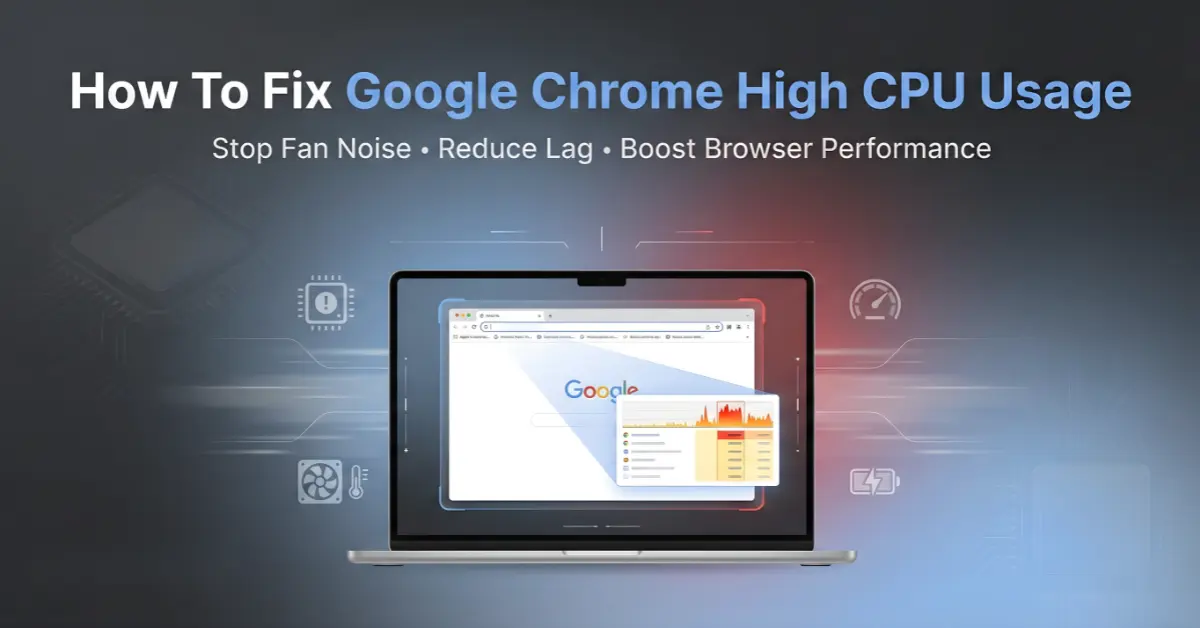
How To Fix Google Chrome High CPU Usage might sound like a job for a computer technician, but beneath the surface lies a surprisingly simple management issue that you have total control over. With the right adjustments to your browser’s internal settings and a quick audit of your extensions, you can stop the lag and silence your cooling fans—and most people don’t even realize how easy it actually is to fix.
By utilizing the built-in Chrome Task Manager and tweaking hardware settings, you can drop CPU usage significantly, saving your battery life and your sanity.
Why Does My Computer Sound Like a Jet Engine?
A few years ago, I was sitting in a perfectly silent library, working on a deadline. Suddenly, the silence was shattered. My laptop fan kicked into overdrive, sounding like a miniature drone preparing for takeoff. People turned to look. I was embarrassed, but mostly, I was frustrated. I wasn’t editing 4K video or gaming; I just had Google Chrome open.
If you’re reading this, you’ve likely been there. You’re trying to work, but your mouse is lagging, your battery is draining before your eyes, and your computer feels hot enough to fry an egg.
Here is the truth: Google Chrome is the most popular browser in the world, but it is also notorious for being resource-hungry. However, it’s rarely “just how it is.” Usually, high resource consumption is a symptom of a specific, fixable problem.
Here’s what you’ll discover in this guide:
- The hidden “detective” tool built into Chrome that 90% of users ignore.
- Why your extensions might be sabotaging your performance.
- The controversial “Hardware Acceleration” setting (and when to turn it off).
- How to handle the mysterious “Software Reporter Tool.”
The “Why”: Understanding Chrome’s Appetite
Before we start flipping switches, it helps to understand why this happens. Unlike older browsers, Google Chrome uses a process-isolation architecture.
In simple terms, Chrome treats every single tab, plugin, and extension as its own separate mini-program. This is brilliant for stability—if one tab crashes, it doesn’t take down the whole browser. But the trade-off is high usage of your system’s resources.
When we talk about high CPU usage, we aren’t just talking about the browser existing; we are usually talking about a specific rogue process inside the browser that has gone off the rails.
The Secret “Detective” Tool Built Right Into Your Browser
Most people instinctively open the Windows Task Manager (or Activity Monitor on Mac) when things get slow. They see “Google Chrome” eating up 80% of their CPU, and they panic.
But that doesn’t tell you the whole story.
Chrome has its own internal Task Manager that is far more granular. This is your first line of defense.
How to use the Chrome Task Manager:
- Open Google Chrome.
- Press Shift + Esc on your keyboard (or click the three dots in the top right corner → More Tools → Task Manager).
- Click the “CPU” column header to sort processes by usage.
What to look for:
You will likely see one specific tab (e.g., a heavy media site) or one specific extension sitting at the top, consuming 40-50% of your CPU.
The Fix:
Highlight the misbehaving process and click End Process.
Expert Note: If you see “GPU Process” utilizing high CPU, that’s a hardware configuration issue, which we will address later in this guide.
Are Your Extensions Secretly Sabotaging Your Speed?
We all love extensions. They block ads, check our grammar, and manage our passwords. But every extension you install adds code that Chrome must run on every single page you visit.
I once worked with a client whose Google Chrome high CPU usage was entirely caused by a coupon-finding extension that was scanning every webpage for discount codes in the background.
The “Elimination Diet” for Extensions
You need to determine if an extension is the culprit.
- Type chrome://extensions in your address bar.
- Toggle all extensions to “Off.”
- Restart Chrome.
If your CPU usage drops instantly, you know one of them is the bad actor. Turn them back on one by one until the usage spikes again.
The Hidden Truth About Hardware Acceleration
This is one of those settings that sounds like a good thing—”Acceleration? Yes, please!”—but it can often cause conflicts between Google Chrome and your computer’s graphics drivers.
Hardware Acceleration is designed to offload heavy graphical tasks (like playing videos) from your CPU to your GPU (Graphics Processing Unit). Theoretically, this lowers CPU usage.
However, if your graphics drivers are slightly outdated or incompatible with Chrome’s current build, this handoff fails. The CPU tries to force the issue, resulting in a massive spike in usage.
How to toggle it safely:
- Go to Settings (click the three dots top right).
- Click on System in the left-hand sidebar.
- Find “Use graphics acceleration when available”.
- If it is ON, turn it OFF. (Or vice versa).
- Relaunch Chrome.
Monitor the results: browse for 10 minutes. Did the fan quiet down? If yes, keep it off.
Taming the “Software Reporter Tool”
If you are on Windows, you might check your Task Manager and see an executable called software_reporter_tool.exe causing high usage.
This is a legitimate tool included with Chrome that scans your computer for software that might conflict with the browser. Ironically, the scanner itself often causes the very lag it’s trying to prevent.
How to stop it (The Expert Method):
You can’t simply “uninstall” it, as Chrome will reinstall it during the next update. But you can block its permissions.
- Navigate to this folder path in Windows Explorer:
%localappdata%\Google\Chrome\User Data\SwReporter - Open the version folder (e.g., 54.209.200).
- Right-click software_reporter_tool.exe and select Properties.
- Go to the Security tab and click Edit.
- Select your user name and check Deny for “Read & Execute.”
This prevents the tool from running without breaking your browser updates.
The “Nuclear Option”: Resetting Without Losing Data
Sometimes, the buildup of cache, cookies, and altered settings creates a “ghost in the machine.” If you’ve tried the steps above and Google Chrome is still hogging your processor, it’s time for a reset.
Why this works:
Over months of use, temporary files can become corrupted. A reset clears the junk but keeps your essential data like bookmarks and passwords (provided you are synced).
- Go to Settings.
- Select Reset settings from the left sidebar.
- Click Restore settings to their original defaults.
Warning: This will disable all extensions (you can turn them back on) and clear temporary data like cookies. It’s a fresh start.
Common Myths About Chrome Performance
There is a lot of bad advice on the internet. Let’s clear up a few misconceptions closely related to CPU usage.
- Myth: “Incognito mode uses less CPU.”
- Truth: Not necessarily. Incognito disables extensions by default, which saves resources, but the rendering engine works exactly the same.
- Myth: “You need to increase Chrome’s priority in Windows.”
- Truth: Setting Chrome to “High Priority” in Windows Task Manager can actually destabilize your system, making your mouse lag and other apps crash.
- Myth: “More RAM solves High CPU.”
- Truth: RAM (Memory) and CPU (Processing) are different. Adding more RAM allows you to open more tabs, but it won’t stop a rogue script from maxing out your processor.
FAQ:
Q: Why is Google Chrome using so much CPU even with one tab open?
A: This is often caused by a background extension or a corrupted cache file. Even a single “New Tab” page can spike CPU if a malware extension is trying to load ads in the background. Check the Chrome Task Manager (Shift + Esc) to pinpoint the hidden culprit.
Q: Is high CPU usage dangerous for my computer?
A: Short-term, no. However, chronic high usage generates excess heat. Over time, this heat can degrade your battery life significantly and put unnecessary wear and tear on your laptop’s cooling fans and internal components.
Q: Does clearing cache fix high CPU usage?
A: It can. If Chrome gets stuck trying to read a corrupted cached file for a website, it can enter a processing loop. Clearing your browsing data (Cached images and files) is a quick, low-risk troubleshooting step.
Q: Chrome vs. Edge: Which is better for CPU?
A: Microsoft Edge is built on the same “Chromium” engine as Google Chrome, so they are very similar. However, Edge has a “Sleeping Tabs” feature enabled by default that aggressively suspends inactive tabs, which often results in slightly lower CPU usage for heavy multitaskers.
Conclusion: Don’t Let Your Browser Boss You Around
Computers are tools designed to speed up our lives, not slow them down. When Google Chrome high CPU usage turns your sleek machine into a sluggish brick, it’s easy to feel helpless.
But as we’ve covered, the solution is rarely to go out and buy a new computer. It’s about maintenance.
Here is your immediate action plan:
- Open Chrome right now.
- Hit Shift + Esc.
- Kill that one process that’s eating 40% of your power.
You will instantly hear the fans spin down, and your computer will take a deep breath. Now that you know how it works, you’re in control.
Do you have a specific extension that was the culprit? Let me know, and we can help warn others!