Summary:
The Google Apple AI deal reshapes how AI reaches billions of users—by embedding it directly into devices and operating systems.
That distribution shift creates a structural disadvantage for OpenAI, even if its models remain competitive.
The real impact is about control, defaults, and long-term market power—not short-term features.
Why This Matters
Most discussions frame this deal as just another Big Tech partnership. That misses the point.
For students, remote workers, and everyday professionals, AI is no longer about which chatbot sounds smarter. It’s about battery life, performance, privacy, and not juggling third-party tools. When AI becomes native to the device, habits change fast.
Common advice still assumes users will “pick the best AI app.” In real-world use, most people stick with what’s already built in.
This guide explains exactly what works, what doesn’t, and how to choose correctly.
What the Google–Apple AI Deal Actually Changes
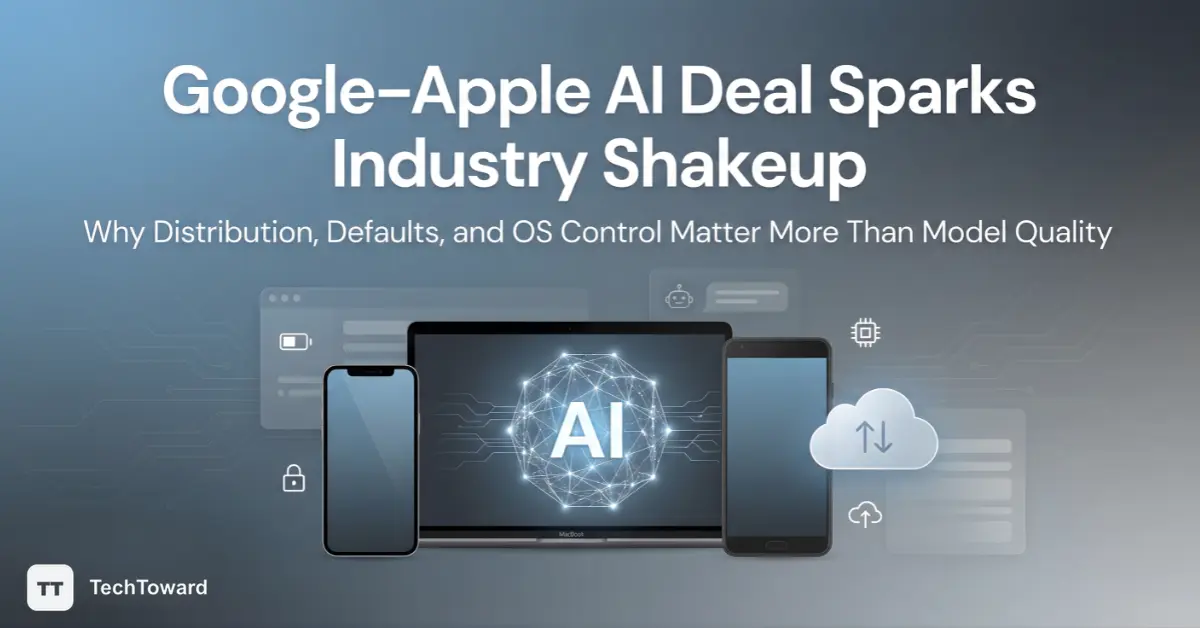
The Google–Apple partnership is not about co-developing a flashy new chatbot. It’s about deep OS-level AI integration.
In practical terms, this means:
- AI features run closer to the hardware
- More tasks handled on-device or with tightly optimized cloud handoff
- Fewer standalone apps and logins
Most users notice this as smoother performance and longer battery life, not as “better AI.”
Why distribution matters more than model quality
OpenAI still leads in several reasoning and creative benchmarks. That advantage matters less when:
- AI features are preinstalled and default
- Access is one tap away, no account friction
- System-level permissions unlock deeper functionality
A common mistake is assuming users actively compare AI models. They don’t. They use what’s already there.
Why This Is a Structural Loss for OpenAI
This is not a talent or innovation problem. It’s a distribution and leverage problem.
OpenAI’s competitive disadvantage is systemic
OpenAI operates primarily as a platform-layer service. Google and Apple control:
- The operating system
- The app store rules
- The default assistant slot
That creates an OpenAI competitive disadvantage that no model upgrade alone can fix.
In real-world use, even power users revert to built-in tools when they are “good enough” and frictionless.
Platform defaults quietly decide winners
History shows this pattern clearly:
- Browsers decided search dominance
- Mobile OS decided app ecosystems
- Defaults decide daily habits
The Google Apple AI partnership impact follows the same logic.
OpenAI remains visible—but no longer central.
How This Shifts the AI Platform Wars in 2026
The AI platform wars 2026 are less about raw intelligence and more about where AI lives.
From apps to ambient AI
AI is moving from:
- Open tabs
- Separate prompts
- Manual copying
To:
- Background assistance
- Context-aware actions
- System-wide presence
Google and Apple are positioning AI as infrastructure, not a destination.
OpenAI, by contrast, still relies on users choosing to open it.
Generative AI Market Power Is Moving Down the Stack
Market power follows control over:
- Hardware access
- OS-level permissions
- Default user flows
The generative AI market power shift favors companies that own at least two of those layers.
OpenAI owns none.
That does not mean OpenAI becomes irrelevant. It means:
- Margins compress
- Negotiating power weakens
- Dependence on partnerships increases
This is a quieter kind of loss—but a lasting one.
What This Means for Everyday Users
For the target audience—students, freelancers, and remote professionals—the impact is practical, not theoretical.
Where the Google–Apple approach wins
- Longer battery life from optimized on-device inference
- Faster responses for common tasks
- Fewer privacy trade-offs for basic workflows
Most users don’t need frontier-level reasoning to summarize notes or draft emails.
Where OpenAI still wins
- Complex reasoning
- Cross-domain creativity
- Advanced coding and research
This creates a split market: default AI vs. specialist AI.
When This Works — and When It Doesn’t
This shift works best for:
- Users who value convenience over customization
- People tired of managing multiple AI tools
- Those who want AI without thinking about it
It works poorly for:
- Power users who chain tools
- Researchers needing transparency and control
- Anyone pushing models to their limits
A clear decision filter: If AI is a background utility, defaults win. If AI is a core work tool, specialists still matter.
Big Tech AI Alliances Change Incentives
Big Tech AI alliances reduce the need for openness.
When companies control the full stack:
- Interoperability becomes optional
- Standards slow down
- Smaller players lose leverage
Most users don’t feel this immediately, but it shapes what’s available two years later.
OpenAI’s risk is not being replaced—it’s being boxed in.
Common Mistakes People Make Interpreting This Deal
- Assuming OpenAI is “losing” because its tech is weaker
The issue is access, not ability. - Thinking users will actively choose the best AI
Defaults quietly dominate behavior. - Believing more features equal better outcomes
In practice, reliability and integration matter more.
Who Should Care Most About This Shift
Should pay attention:
- Students relying on laptops and tablets all day
- Remote workers sensitive to battery and performance
- Freelancers avoiding tool overload
Can mostly ignore it (for now):
- AI researchers
- Heavy automation builders
- Users already locked into custom workflows
This is a mass-market shift, not a niche one.
FAQs
Is this deal bad for OpenAI long term?
Yes, structurally. It limits distribution leverage even if model quality stays high.
Does this mean OpenAI will disappear from consumer use?
No. It becomes a specialist tool rather than the default assistant.
Will Google and Apple AI be “better” than OpenAI?
For everyday tasks, often yes. For advanced work, not consistently.
Is this about privacy or control?
Both. On-device AI improves privacy while increasing platform control.
Can OpenAI counter this disadvantage?
Only through deeper partnerships or new distribution channels—not model upgrades alone.
Final Takeaway
The Google Apple AI deal is a turning point because it changes where AI lives, not how smart it sounds. That shift creates a real OpenAI loss—not in innovation, but in default relevance.
With a clear understanding of how this works, readers can now choose the option that actually fits their needs — without guesswork.