Summary
InVideo AI is an AI video generator platform that turns simple text prompts into ready-to-publish videos using automated scripting, visuals, voiceovers, and editing. It is designed for creators, marketers, and businesses that need consistent video output without traditional production complexity. For many users in 2026, the real question is not whether it works — but whether it replaces manual editing tools or simply accelerates them.
Why AI Video Creation Feels Urgent in 2026
Short-form content dominates feeds. Long-form educational content is thriving on platforms like YouTube. Brands expect daily social visibility. And audiences have become accustomed to polished visuals, captions, and storytelling — even from small creators.
The demand for video has expanded faster than most teams can realistically produce it.
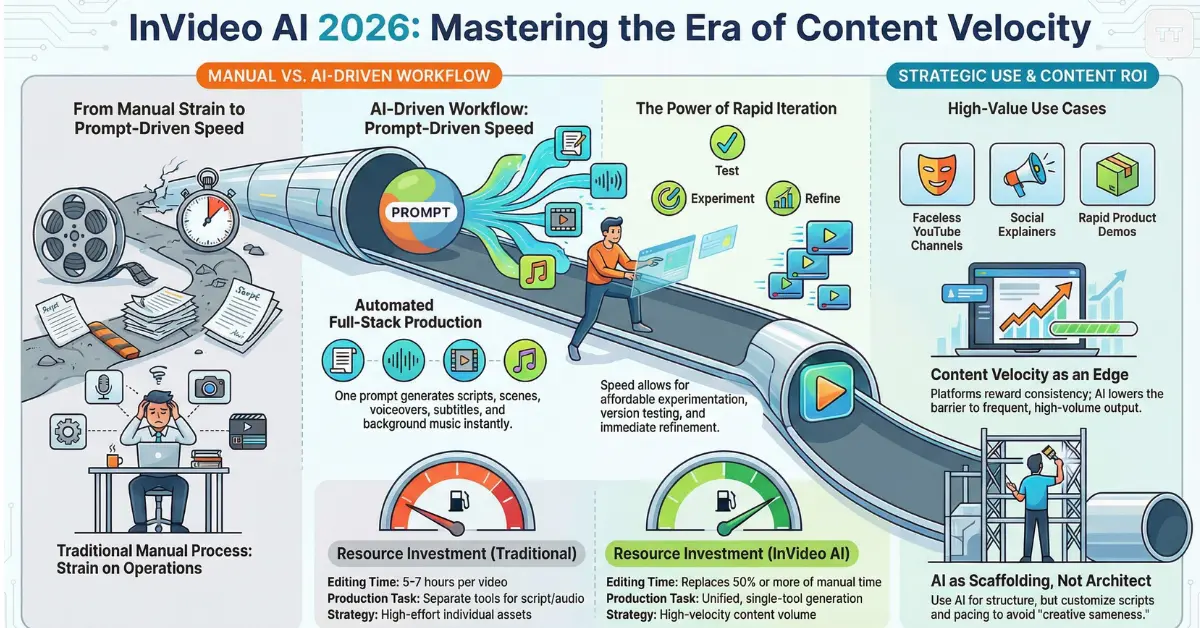
Many creators still approach video as a manual process: scripting in one tool, editing in another, recording voiceovers separately, sourcing stock footage, and adjusting captions manually. That workflow worked in 2020. It strains operations in 2026.
This is where InVideo AI positions itself — not merely as editing software, but as a text-to-video AI tool that compresses the entire production pipeline into a single prompt-driven workflow.
What most discussions overlook is that speed alone is not the value. The deeper advantage is iteration. When a video can be generated, modified, and regenerated within minutes, experimentation becomes affordable.
What InVideo AI Actually Does (Beyond the Marketing Claims)
At its core, InVideo AI converts a text instruction into a structured video. A prompt such as “Create a 60-second explainer about sustainable investing for beginners” triggers multiple automated processes:
- Script generation
- Scene breakdown
- Stock media selection
- AI voiceover
- Subtitles and formatting
- Background music layering
The user does not begin with a timeline. They begin with intent.
Unlike traditional editing suites, the process feels closer to prompting an AI writing assistant — but the output is a visual sequence instead of text.
This shift matters because it removes friction at the ideation stage. Many creators struggle not with editing skill, but with starting. By automating structure, InVideo AI reduces the blank-page effect.
However, automation also introduces a tradeoff: creative unpredictability. The generated visuals are context-aware but not brand-intuitive. Users who expect cinematic originality may find the first output generic.
Feature Set in 2026: Where It Competes and Where It Doesn’t
The 2026 version has matured beyond basic slideshow-style outputs. It now supports:
- Conversational script tone adjustments
- Multiple voice profiles and accents
- Platform-specific aspect ratios
- Real-time prompt refinement
- Brand color and logo integration
- Scene-level editing after generation
The platform competes in the same category as tools often mentioned among the best AI video tools for marketers, but its strength lies in accessibility rather than deep cinematic control.
Where it excels:
- Educational YouTube content
- Social explainer clips
- Product demos
- List-style informational videos
Where it struggles:
- Highly emotional storytelling
- Advanced motion graphics
- Complex brand animation sequences
This distinction is critical. InVideo AI is built for scalability, not artistry. Creators who prioritize efficiency over intricate editing benefit most.
The Pricing Question in 2026
InVideo AI pricing 2026 reflects a shift in how AI software is structured: usage-based value rather than static access. Plans typically scale based on export limits, premium assets, voice minutes, and watermark removal.
The entry tier works for experimentation and short social clips. Professional tiers suit consistent publishing schedules. Enterprise-level pricing addresses agencies managing multiple client brands.
What matters is not the monthly fee — but the replacement cost.
If a solo YouTuber spends:
- 5–7 hours per video on editing
- Additional hours scripting and sourcing footage
Then the software becomes cost-effective once it replaces even half that time.
The overlooked cost is revision fatigue. Manual editing often discourages iteration. AI-based workflows encourage version testing, which can increase engagement performance over time.
For startups and lean teams, the calculation becomes strategic: time saved often converts directly into distribution gains.
Is It Suitable as AI Video Creation Software for YouTube?
For YouTube creators, the answer depends on niche and format.
Educational, commentary, listicle, and business channels benefit the most. The platform’s structure-driven outputs align well with informational content where clarity outweighs cinematic style.
However, vloggers, filmmakers, and personality-driven creators may find it limiting. Authenticity on YouTube often relies on human presence, facial expressions, and real-world footage.
A common misconception is that AI video tools replace creators. In practice, they augment them.
Creators increasingly use InVideo AI to:
- Produce supplementary content
- Create faceless educational channels
- Repurpose blog posts into video
- Test niche ideas before investing in full production
The strongest results often occur when creators blend AI-generated structure with personal customization.
The Strategic Advantage Most People Miss
The biggest advantage of AI video tools is not automation — it is content velocity.
Platforms reward consistency. Algorithms prioritize frequency and watch time stability. AI generation lowers the barrier to consistent output.
This shifts the competitive landscape. Smaller creators can now produce at volumes previously reserved for agencies.
Yet volume without differentiation leads to saturation.
The real strategy is combining AI speed with unique perspective. Prompting the tool with distinctive insights yields more original outputs. Generic prompts produce generic videos.
This is where judgment becomes decisive.
Common Misconceptions About AI Video Platforms
“AI-generated videos are low quality.”
Quality depends heavily on input clarity. Vague prompts produce surface-level scripts. Specific prompts produce structured narratives.
“It eliminates creative control.”
While automation handles the first draft, scene-by-scene editing remains available. The tool accelerates structure; it does not eliminate refinement.
“It’s only for beginners.”
Many experienced marketers use AI tools precisely because they understand the economics of time. Automation does not imply inexperience; it implies prioritization.
Comparing It to Other AI Video Solutions
The broader AI video generator platform ecosystem includes tools focused on avatars, animation, or cinematic generation.
InVideo AI occupies a middle ground:
- More automated than traditional editors
- More flexible than avatar-only platforms
- Less customizable than advanced motion software
For marketers seeking campaign scalability, it ranks among the best AI video tools for marketers because it balances speed with usability.
For designers who value motion precision, advanced editing suites may still dominate.
Choosing correctly depends less on features and more on workflow philosophy.
Use Cases That Deliver the Strongest ROI
1. Faceless YouTube Channels
Educational finance, tech explainers, productivity tips, and business analysis channels can scale quickly with AI scripting and stock visuals.
2. Startup Product Launch Videos
Founders often need clear explainer videos without hiring production teams. AI-generated structure provides a cost-effective starting point.
3. Social Media Repurposing
Long blog posts can be converted into short-form videos optimized for vertical platforms.
4. Marketing Campaign Variations
Multiple versions of a campaign can be generated and A/B tested rapidly.
The key limitation is brand storytelling nuance. Premium brands that rely heavily on emotional resonance may still require human-led production.
The Overlooked Limitation: Creative Convergence
As AI tools become widely adopted, stylistic similarity increases.
Many AI-generated videos share:
- Stock-heavy visuals
- Structured voiceover pacing
- Similar subtitle animations
Over time, audiences may recognize the pattern.
Creators who rely entirely on default outputs risk blending into a sea of similar content.
The solution is not avoiding AI — it is customizing aggressively. Adjust scripts, modify pacing, insert original clips, refine voice selection. Use AI as scaffolding, not as the final architect.
When It Is Worth It — And When It Isn’t
InVideo AI is worth it for:
- Solo creators producing informational content
- Agencies managing multiple clients
- Marketers needing rapid experimentation
- Founders validating ideas quickly
It may not be worth it for:
- Cinematic filmmakers
- Highly personality-driven creators
- Brands requiring bespoke animation
- Users unwilling to refine AI outputs
The platform rewards users who treat it as a collaborative assistant rather than a one-click solution.
Broader Industry Context: AI and the Future of Video
The acceleration of AI video tools mirrors broader trends in generative technology. Text, image, and audio creation have already been transformed. Video was the last complex frontier.
The shift affects not just production but distribution economics.
As automation increases supply, differentiation shifts toward:
- Narrative insight
- Personal authority
- Strategic positioning
Tools reduce barriers. Strategy defines success.
In this environment, AI video platforms do not eliminate competition — they intensify it.
Frequently Asked Questions
Is InVideo AI beginner-friendly?
Yes. It is designed to require minimal editing experience. Most workflows start with a simple text prompt, and the platform handles structure automatically, making it accessible even to first-time creators.
Can AI-generated videos be monetized on YouTube?
Yes, provided they comply with platform policies and include original value. Channels that add unique scripting, insight, or commentary perform better than those relying purely on generic outputs.
Does it replace professional video editors?
Not entirely. It replaces repetitive production tasks but does not match advanced cinematic editing or high-end animation control.
How accurate are AI-generated scripts?
Accuracy depends on prompt clarity and topic specificity. Users should always review and refine scripts, particularly for technical or financial topics.
Is the pricing justified for small creators?
For creators publishing consistently, time savings often justify the cost. For occasional users, the value depends on output frequency and revenue goals.
Final Verdict: A Tool for Acceleration, Not Substitution
InVideo AI represents a structural shift in how video content is produced. It transforms the starting point from timeline editing to idea prompting. That alone changes creative momentum.
Its greatest strength is speed and scalability. Its greatest weakness is creative sameness if left unrefined.
For creators and marketers who understand their audience, refine their messaging, and use automation strategically, the platform can be a powerful amplifier.
For those expecting one-click originality, expectations may exceed reality.
In 2026, the competitive edge no longer belongs to those who can edit video — it belongs to those who can think clearly, communicate sharply, and iterate quickly. Tools like InVideo AI simply make that process faster.