Summary
Microsoft glass data storage represents a breakthrough in long-term digital preservation, using specially engineered quartz glass to store information that can last up to 10,000 years. Unlike traditional magnetic tape or hard drives, this approach focuses on ultra-long-term data archiving with extreme durability and minimal environmental impact. For governments, research institutions, and enterprises facing compliance and sustainability pressures, it signals a structural shift in how archival data is protected.
Introduction: The Archival Problem No One Solved Until Now
For decades, digital transformation promised permanence. In reality, it delivered fragility.
Hard drives fail. Tape degrades. Cloud archives require continuous migration to avoid obsolescence. Every few years, enterprise IT teams quietly perform large-scale data transfers just to prevent loss from aging media. This cycle is costly, energy-intensive, and operationally risky — particularly for institutions responsible for records that must outlive infrastructure, vendors, and even governments.
What most coverage overlooks is that the real challenge of archival storage is not capacity. It is durability without dependency. Long-term preservation today depends on constant power, active management, and repeated hardware refresh cycles.
Microsoft’s work in quartz glass data storage challenges that entire assumption.
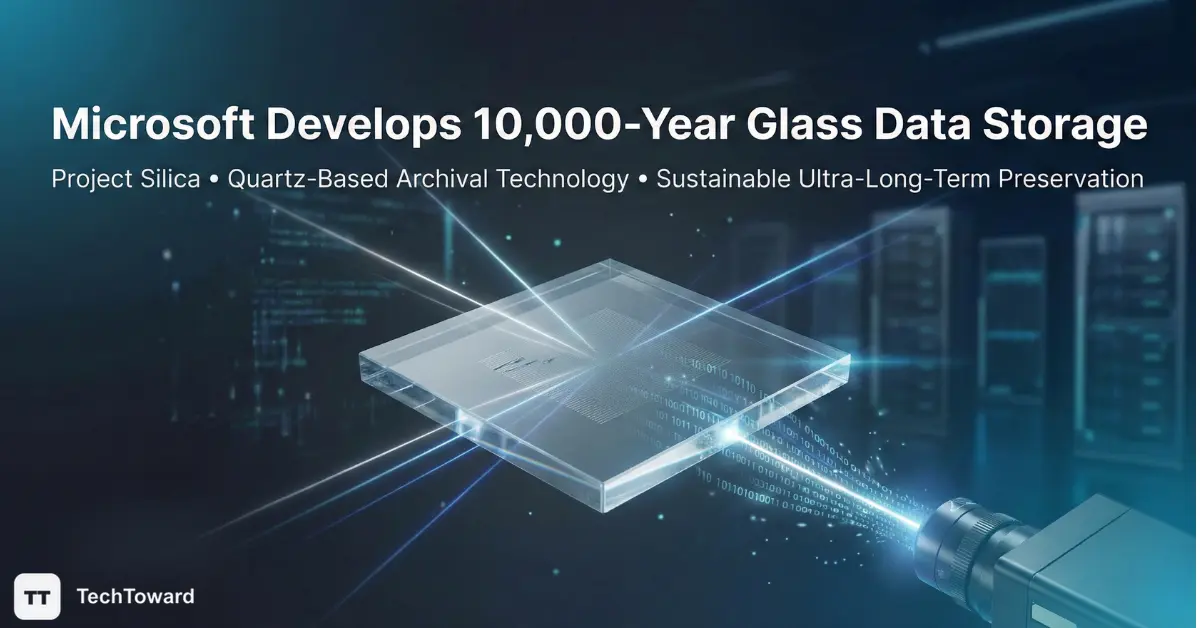
Under its research initiative known as Project Silica storage technology, Microsoft has demonstrated a 10,000-year data storage medium etched into glass — not metaphorically, but physically, using ultrafast lasers to encode data in three dimensions. The implications extend far beyond novelty. This is about redefining the lifecycle of archival data itself.
From Magnetic Decay to Optical Permanence
Modern archival systems largely rely on magnetic tape libraries. Tape remains cost-effective at scale and is widely used in cold storage tiers across hyperscale cloud providers. However, even enterprise-grade tape typically carries a practical lifespan of 20 to 30 years under ideal conditions. Realistically, migration cycles occur more frequently.
Glass, by contrast, behaves differently at a material level.
The quartz substrate used in Microsoft’s glass storage system is chemically stable, resistant to electromagnetic interference, and tolerant to extreme environmental conditions. It does not require climate-controlled vaults to maintain structural integrity. It does not corrode, oxidize, or demagnetize.
The encoding process uses femtosecond lasers to create nanoscale structures within the glass. These microscopic deformations alter how polarized light passes through the material. Data is read by analyzing these optical changes with machine learning-based decoding systems.
The critical shift here is this: the storage medium is passive. Once written, it does not require energy to maintain its state.
For archival applications, that single attribute changes cost modeling, sustainability calculations, and operational risk assessments.
Why 10,000 Years Matters More Than It Sounds
The phrase “10,000-year data storage” may initially sound symbolic. In practice, it addresses a long-standing policy dilemma.
Government agencies, national archives, space exploration programs, scientific research bodies, and global cultural institutions increasingly generate datasets that must survive for centuries. Climate models, genomic libraries, historical records, and legal documents cannot be subject to routine media obsolescence.
Today, compliance frameworks often assume ongoing technological continuity. That assumption is fragile.
If preservation requires continuous hardware refreshes and format migrations, then long-term survival depends on uninterrupted institutional stability. History suggests that assumption is unreliable.
A storage medium that remains readable across millennia reframes the problem. Instead of planning for the next migration cycle, organizations can treat archival data as a static artifact — more like a manuscript stored in stone than a file in a server rack.
That psychological shift alone may influence how preservation policies are written over the next decade.
Project Silica Storage Technology: Beyond the Demonstration Phase
Project Silica storage technology began as an experimental research effort within Microsoft’s cloud and research divisions. Early demonstrations included encoding a full-length feature film into a glass slab roughly the size of a drink coaster.
What distinguishes the current phase is the transition from laboratory feasibility to enterprise evaluation.
Microsoft has tested the medium under stress conditions including:
- High temperatures
- Microwaves
- Demagnetization attempts
- Surface damage and scratching
The encoded data remained intact.
However, the overlooked detail is not durability alone — it is retrieval architecture.
Glass storage is not designed for high-frequency access. It is not a replacement for SSD arrays or hot cloud tiers. Instead, it is architected as a deep archival layer, potentially below tape in the hierarchy. Data would be written once, rarely accessed, and preserved indefinitely.
This distinction is essential for decision-makers. Misunderstanding its purpose could lead to unrealistic performance expectations.
Sustainability Is the Hidden Strategic Driver
Data centers are under increasing scrutiny for energy consumption and carbon footprint. While most attention focuses on compute efficiency and cooling optimization, storage infrastructure quietly contributes to long-term energy use through:
- Continuous environmental control
- Power requirements for tape robotics and disk arrays
- Migration processes that duplicate data across generations
Sustainable data preservation solutions must consider lifecycle impact, not just per-terabyte energy metrics.
Glass storage introduces a model where archived data consumes zero power after writing. No spinning disks. No periodic rewrites. No standby electricity.
Over decades, that difference compounds.
For hyperscale operators and national institutions facing climate reporting mandates, this shifts sustainability conversations from incremental efficiency improvements to structural reduction of long-term energy dependency.
The environmental narrative is not marketing language. It is a strategic compliance advantage.
Tradeoffs Enterprises Must Evaluate
Despite its promise, Microsoft glass data storage is not a universal solution.
Several practical considerations shape its adoption trajectory:
Write Speed and Access Latency
Laser inscription is slower than writing to tape or disk. Retrieval also requires specialized optical scanning equipment and decoding systems. This is acceptable for ultra-long-term archiving but unsuitable for operational workloads.
Cost at Scale
Although glass itself is abundant and stable, the inscription and reading systems involve advanced hardware. Early adoption costs may exceed traditional archival options until economies of scale mature.
Ecosystem Dependence
The medium’s longevity does not eliminate the need for future-compatible readers. While the glass may survive 10,000 years, decoding systems must remain reproducible. Documentation and open standards will determine long-term accessibility.
This final point is frequently overlooked. Durability without readability is not preservation.
Rethinking Archival Architecture in 2026
The introduction of quartz glass data storage invites a deeper architectural question: should archival systems be active infrastructure or physical artifacts?
Traditional cold storage tiers still assume periodic verification, refresh cycles, and infrastructure presence. Glass storage suggests a model closer to physical vaulting — data as a stable object rather than a continuously managed service.
For cloud architects designing multi-tier storage strategies, this could lead to a four-layer model:
- Hot operational storage
- Nearline and backup tiers
- Long-term cold storage (tape)
- Ultra-long-term glass-based preservation
This layered approach reduces reliance on recurring migrations for the deepest archive layer.
Institutions with century-scale mandates — such as national archives or space agencies — may find this especially compelling.
The Compliance and Governance Implications
In sectors such as healthcare, defense, and scientific research, regulatory retention periods continue expanding. Some mandates now stretch beyond human career spans.
Ultra-long-term data archiving shifts compliance planning from decades to eras.
However, governance frameworks must adapt. Policies designed for erasable, re-writable media may not align with write-once glass substrates. Legal teams will need to evaluate:
- Data deletion obligations
- Right-to-erasure requirements
- Encryption strategies for centuries-long confidentiality
Encryption longevity introduces another overlooked challenge. Cryptographic standards evolve rapidly. Data intended to last millennia must either use future-resilient encryption models or include provisions for periodic re-encryption before cryptographic obsolescence.
In this context, the medium solves physical durability — but cryptographic durability remains an open strategic issue.
A Shift in How Preservation Is Valued
Perhaps the most transformative insight is cultural rather than technical.
Digital systems historically prioritized speed, convenience, and scale. Longevity was secondary because migration felt manageable.
Glass storage reframes data as heritage.
Scientific discoveries, cultural artifacts, and public records gain a preservation medium comparable to etched stone or engraved metal — yet with digital density.
This convergence between ancient durability and modern information density alters how institutions may value digital archives. Instead of treating them as operational burdens, they may begin treating them as civilization-scale assets.
That shift influences funding, procurement strategy, and long-term planning.
Who Should Consider Adoption and Who Should Wait
Microsoft glass data storage is particularly suited for:
- National archives and cultural preservation institutions
- Scientific research repositories
- Space exploration data programs
- Large enterprises with century-scale compliance mandates
It is less suited for:
- Rapid-access analytics platforms
- High-frequency data retrieval environments
- Organizations without clear long-term retention requirements
Adoption in 2026 is likely to be selective and strategic rather than widespread. Early adopters will prioritize permanence over speed.
For many enterprises, a hybrid approach combining tape and glass may be the most practical interim strategy.
People Also Read: Mark Zuckerberg Blames Wi-Fi After Meta AI Smart Glasses Demo Fail
Frequently Asked Questions
What is Microsoft glass data storage?
It is a storage technology that uses laser-etched quartz glass to preserve digital data for up to 10,000 years. The medium is highly durable and designed for ultra-long-term archival use rather than everyday access.
How does Project Silica storage technology differ from tape storage?
Tape relies on magnetic encoding and requires periodic migration, while glass storage encodes data optically within the material itself. Glass does not degrade in the same way and does not require power to maintain stored data.
Is 10,000-year data storage practical or theoretical?
Laboratory testing demonstrates extreme durability under environmental stress. However, large-scale commercial deployment will depend on cost optimization and standardized reader systems.
Can glass storage replace cloud archives?
It is not intended to replace cloud infrastructure but to complement it as a deep archival layer. Operational and frequently accessed data will continue to rely on traditional storage tiers.
Is quartz glass data storage environmentally sustainable?
Yes, primarily because archived data requires no ongoing power consumption after inscription. This reduces long-term energy use compared to continuously maintained storage systems.
What is the biggest limitation of ultra-long-term data archiving on glass?
Access speed and ecosystem maturity remain constraints. Additionally, long-term cryptographic strategy must be carefully planned to ensure confidentiality over centuries.
Conclusion: From Storage Media to Civilizational Memory
Microsoft’s advancement in glass-based storage is not merely a technological milestone; it represents a philosophical shift in digital preservation.
Instead of assuming perpetual migration, it proposes permanence. Instead of designing archives around hardware refresh cycles, it designs them around material stability.
The most forward-looking institutions will recognize that data longevity is no longer just an IT problem — it is a strategic continuity issue.
As archival demands expand and sustainability pressures intensify, durable, passive preservation mediums may move from experimental curiosity to foundational infrastructure.
The future of archival technology may not spin, hum, or blink with activity. It may sit silently — etched in glass — waiting for the next millennium to read it.