Summary
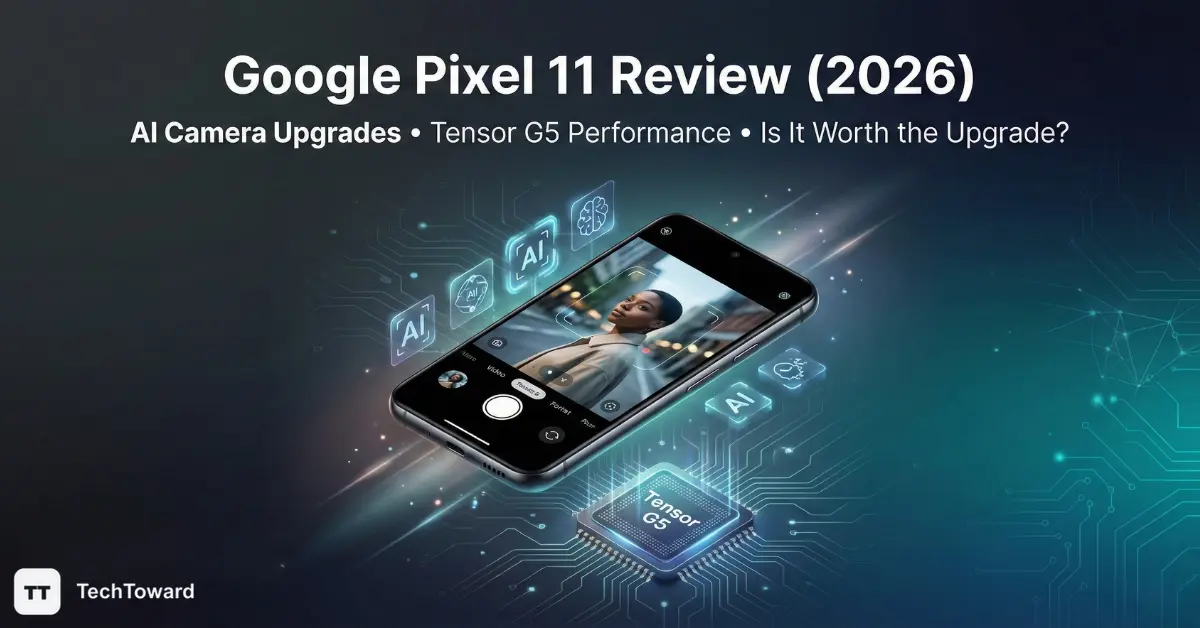
The Google Pixel 11 represents Google’s most AI-focused flagship yet, combining advanced on-device intelligence with refined hardware performance. Powered by the new Tensor G5 chip, it delivers noticeable gains in image processing, battery efficiency, and real-world responsiveness. For buyers considering a premium Android upgrade in 2026, the key question is not just how fast it is—but whether its AI-driven experience meaningfully improves everyday use.
A Flagship That Doubles Down on Intelligence, Not Just Specs
Many flagship launches in 2026 revolve around brighter displays, higher megapixel counts, or faster charging claims. The Pixel 11 takes a different route. Rather than chasing spec-sheet dominance, it leans heavily into artificial intelligence as a practical advantage.
That distinction matters. Premium buyers in the US, UK, AU, and EU markets are no longer impressed by incremental hardware bumps alone. They want smarter software integration, longer software support, and cameras that adapt intuitively to real-world scenarios. The Pixel line has long positioned itself around computational photography and clean Android experiences. With the Pixel 11, that identity becomes more pronounced—and more mature.
What most early overviews miss is that this device is less about raw horsepower and more about sustained intelligence over time. The improvements feel subtle on paper but tangible in daily use.
Tensor G5: Performance That Feels Different, Not Just Faster
At the center of the Pixel 11 is Google’s fifth-generation custom silicon. The Tensor G5 performance benchmark numbers show clear generational improvements over the previous chip, especially in AI workloads and thermal management. But raw scores only tell part of the story.
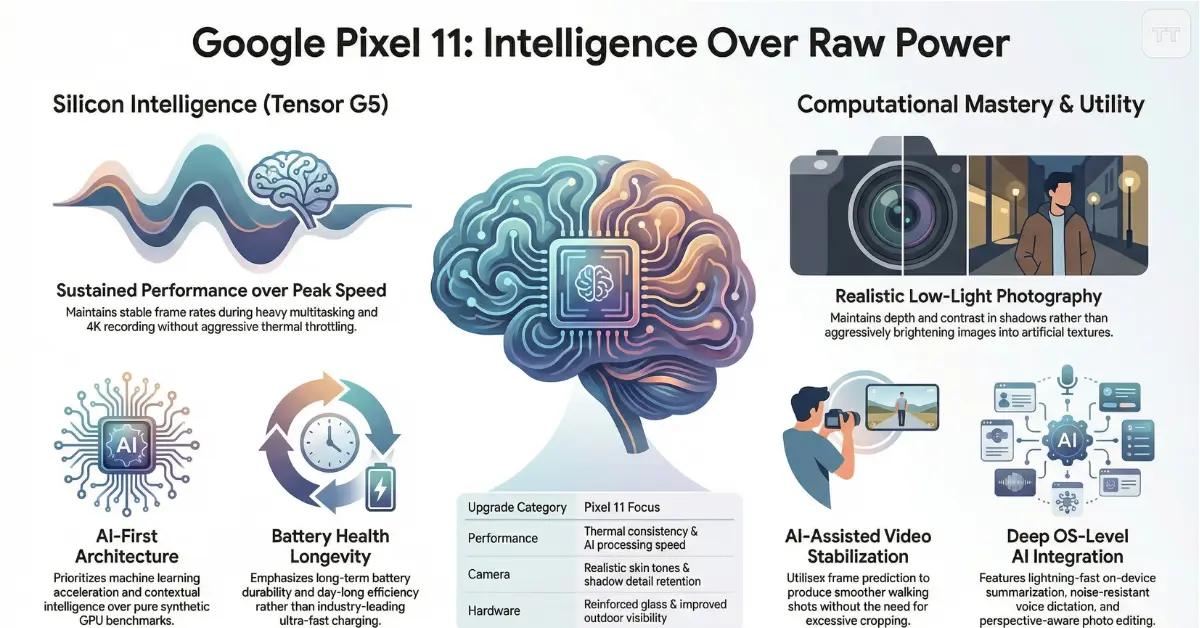
Where the chip stands out is in sustained performance. During extended gaming sessions, 4K video recording, or live translation tasks, the device maintains stable frame rates and avoids aggressive throttling. That indicates improved efficiency rather than simply higher peak speeds.
Compared to the prior model, app launches feel more immediate, and multitasking transitions are smoother. Heavy productivity users—those who run split-screen apps, video calls, and document editing simultaneously—will notice fewer slowdowns.
However, this is not the most powerful Android chip in synthetic GPU benchmarks. Devices powered by the latest Snapdragon or Dimensity platforms may edge ahead in pure gaming metrics. The tradeoff is clear: the Tensor G5 prioritizes AI acceleration and contextual intelligence over maximum graphics throughput.
For most users, that is the more practical choice. Competitive mobile gamers chasing absolute frame rates may prefer alternatives. Everyone else benefits from smarter system behavior.
Camera Evolution: Beyond Megapixels
The Pixel series has built its reputation on camera consistency. The Pixel 11 continues that trajectory, but the real shift lies in software intelligence rather than hardware overhaul.
In early Pixel 11 camera test results, dynamic range handling shows improved scene detection accuracy, particularly in mixed lighting environments. The device better distinguishes subjects from complex backgrounds, leading to more natural portrait separation and more accurate skin tones.
Low-light photography is notably cleaner. Instead of aggressively brightening shadows—which sometimes created artificial textures in earlier models—the new processing pipeline maintains depth and contrast. Night photography feels more realistic and less over-processed.
Video stabilization also benefits from AI-assisted frame prediction. Walking shots appear smoother without excessive cropping. For creators who film social media content or casual travel vlogs, this refinement is significant.
An overlooked improvement is color science consistency across lenses. Switching between ultra-wide and main sensors now produces less noticeable color shift. That small detail enhances usability for photographers who care about tonal accuracy.
Yet, it is important to note a limitation: zoom performance remains competitive but not class-leading. Optical reach is adequate, and computational enhancement is strong, but some rivals push further with periscope hardware.
For everyday photography, though, the Pixel 11 arguably remains one of the most reliable options in the premium category.
AI Features That Move From Novelty to Utility
The Pixel 11 AI features are where the device distinguishes itself most clearly from competitors. Many brands claim AI integration, but few embed it deeply across the operating system.
On-device summarization for emails and documents is faster and more context-aware. Voice dictation accuracy improves in noisy environments, making it more viable for professionals drafting messages on the go. Live translation handles more accents with improved responsiveness, particularly in offline scenarios.
Smart photo editing tools evolve beyond simple object removal. The system now understands lighting direction and perspective more convincingly when reconstructing background elements. That reduces the artificial look often associated with generative edits.
However, not every AI feature will matter to every buyer. Users who primarily browse, stream, and text may not fully leverage these tools. The greatest value emerges for those who create content, manage frequent communications, or travel internationally.
The insight here is that AI usefulness scales with user complexity. The more dynamic the workflow, the more meaningful these enhancements become.
Pixel 11 vs Pixel 10: A Meaningful Leap or Iterative Step?
A Pixel 11 vs Pixel 10 comparison reveals a nuanced answer. The design language remains familiar. Display quality improves incrementally, with better peak brightness and slightly refined calibration. Battery endurance sees modest gains through efficiency rather than capacity increase.
The true upgrade lies in three areas:
- AI processing speed
- Thermal consistency
- Camera intelligence refinements
If the Pixel 10 already satisfies daily performance needs, upgrading purely for speed may not be compelling. However, users who rely heavily on computational photography or multitasking will feel the difference.
Those holding devices older than two generations will see a far more dramatic jump, particularly in AI responsiveness and sustained performance.
The decision ultimately depends on usage patterns rather than marketing claims.
Display, Design, and Build: Polished Familiarity
The Pixel 11 maintains Google’s clean, understated design philosophy. The matte finish resists fingerprints better than glossier alternatives. The camera bar remains distinctive yet more seamlessly integrated into the chassis.
The display delivers vibrant colors without oversaturation. Outdoor visibility improves noticeably, making it practical for travel and commuting use in bright conditions.
Durability enhancements, including reinforced glass and improved water resistance, increase long-term reliability. In markets where consumers expect phones to last three to four years, this matters more than marginal speed improvements.
The device feels refined rather than reinvented. That may disappoint those expecting dramatic aesthetic shifts, but it reinforces stability and brand identity.
Battery Life and Charging: Efficiency Over Flash
Battery life reflects optimization rather than dramatic capacity increases. Moderate users can comfortably reach the end of a full day, even with photography and navigation tasks included.
Charging speeds remain competitive but not industry-leading. Some rivals push ultra-fast charging as a headline feature. Google’s approach emphasizes battery health longevity instead.
This presents a subtle tradeoff. Users who value rapid top-ups may prefer alternatives. Those prioritizing long-term battery durability may appreciate the conservative strategy.
Over time, this approach aligns with sustainability trends and extended device lifecycles.
The Competitive Landscape in 2026
When evaluating the best Android flagship 2026 contenders, context is essential. Competitors focus heavily on gaming performance, aggressive camera zoom hardware, or ultra-fast charging technologies.
The Pixel 11 competes differently. It offers:
- Deep AI integration
- Consistent camera reliability
- Clean software with long-term updates
- Balanced performance without overheating
For tech enthusiasts who value raw benchmarks above all else, other devices may appear more impressive on paper. For those seeking cohesive intelligence across photography, productivity, and daily tasks, the Pixel 11 feels purpose-built.
This difference in philosophy defines its position in the market.
Who Should Consider the Pixel 11?
The Pixel 11 suits users who:
- Care about realistic, reliable photography
- Value software longevity and AI integration
- Prefer clean Android without heavy interface overlays
- Multitask frequently and rely on voice tools
It may not be ideal for:
- Hardcore competitive mobile gamers seeking peak GPU scores
- Buyers prioritizing ultra-fast charging above all
- Users who upgrade annually regardless of incremental gains
Understanding this alignment prevents disappointment and sets realistic expectations.
Overlooked Limitation: AI Dependency and Long-Term Value
One rarely discussed factor is the increasing reliance on AI-driven features. As more core experiences depend on machine learning processing, long-term software support becomes even more critical.
If AI tools define daily workflows, losing updates earlier than expected could impact usability more than it would on older devices. Fortunately, Google’s extended update commitment mitigates this risk. Still, buyers should consider how dependent they want their workflow to be on evolving AI systems.
The Pixel 11 works best for those comfortable with rapid software evolution and cloud-integrated services.
People Also Read: Is the Google Pixel 10 Pro XL really worth the hype it’s getting in 2026?
Frequently Asked Questions
Is the Pixel 11 a major upgrade over the Pixel 10?
It is a meaningful upgrade primarily in AI processing and thermal consistency. Users with older models will notice greater improvements than recent upgraders.
How strong is Tensor G5 performance compared to other 2026 chips?
It delivers excellent sustained performance and AI acceleration but may not top raw gaming benchmarks. The focus is efficiency and intelligent task handling.
Are the Pixel 11 camera improvements noticeable in daily use?
Yes. Low-light realism, color consistency, and smarter subject detection improve everyday photography results without requiring manual adjustments.
Does the Pixel 11 have the best battery life among flagships?
Battery life is solid and reliable, though not record-breaking. Its efficiency strategy favors long-term health over extreme fast charging.
Is it the best Android flagship of 2026?
It depends on priorities. For AI-driven productivity and camera reliability, it ranks among the strongest options. For maximum gaming power, other devices may lead.
Conclusion: A Flagship That Rewards the Right User
The Google Google Pixel 11 is not designed to win every specification battle. Instead, it refines what Google does best: intelligent photography, practical AI tools, and balanced performance.
Its greatest strength lies in cohesion. Hardware, software, and machine learning work together rather than competing for headline numbers. For users whose daily routines involve communication, content creation, and multitasking, this integration feels transformative.
Those seeking dramatic aesthetic changes or benchmark dominance may look elsewhere. But for buyers who value thoughtful evolution over spectacle, the Pixel 11 represents one of the most strategically balanced premium smartphones of 2026.
At this point in the flagship market, smarter often matters more than faster—and this device embraces that philosophy with confidence.