Summary:
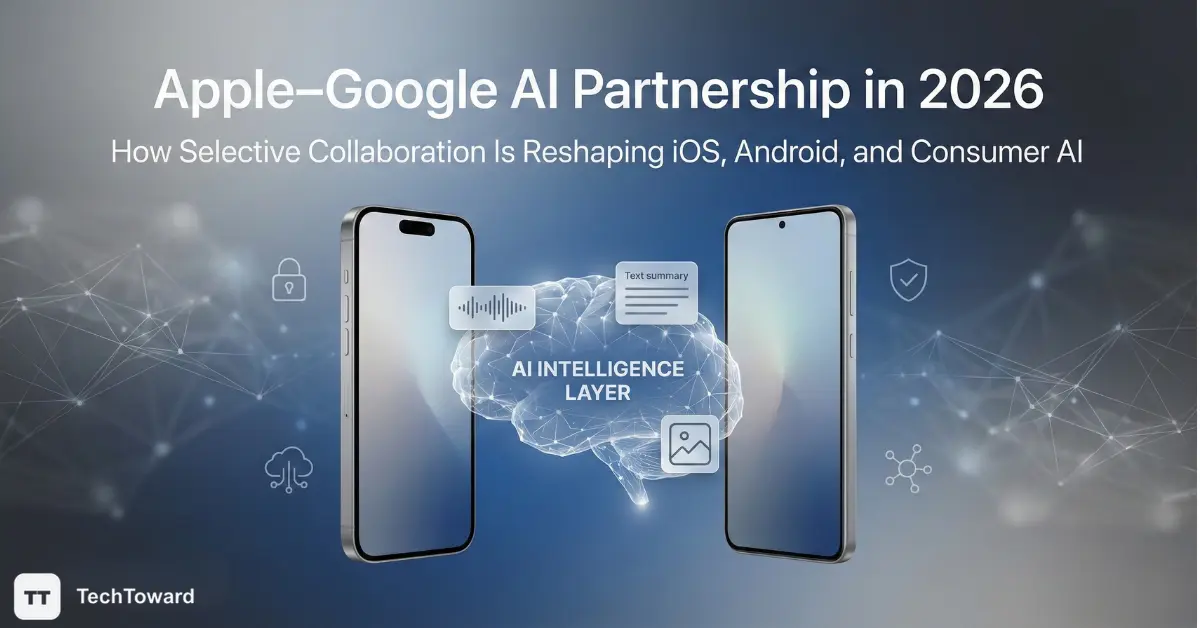
In 2026, Apple and Google’s evolving AI partnership signals a shift from isolated platform intelligence toward selective collaboration across consumer ecosystems. Rather than merging strategies, both companies are aligning where it improves user experience, model performance, and regulatory positioning—especially across iOS and Android. The result is a more interconnected AI layer that subtly reshapes how devices, apps, and services behave for everyday users.
Introduction: Why This Partnership Matters Now
For over a decade, Apple and Google have been framed as ideological opposites in consumer technology—one prioritizing control and privacy, the other scale and data-driven optimization. That narrative is no longer sufficient to explain what is happening in AI.
By 2026, artificial intelligence has become infrastructure rather than a feature. Voice assistants, on-device models, generative tools, and predictive systems are no longer optional enhancements; they define how users interact with smartphones, apps, and cloud services. In this environment, even rivals are finding selective cooperation more practical than rigid isolation.
Most coverage treats the Apple–Google AI partnership as either a surprising détente or a quiet licensing arrangement. What is often missed is the deeper implication: this collaboration reflects how big tech is reorganizing power, responsibility, and differentiation in an AI-saturated market. Understanding this shift requires looking beyond announcements and into how iOS, Android, developers, and consumers are affected in real terms.
From Competition to Conditional Collaboration
Apple and Google never stopped competing. What changed is where competition makes sense.
Historically, both companies built vertically integrated AI stacks—Google through cloud-first machine learning and Apple through tightly controlled on-device intelligence. By 2026, those approaches have collided with practical limits. Training frontier models is capital-intensive, regulatory scrutiny has intensified, and user expectations have outpaced what isolated ecosystems can comfortably deliver.
The current collaboration reflects conditional alignment rather than strategic unity. Apple gains access to specific generative capabilities and research outputs without surrendering platform control. Google benefits from broader model distribution and relevance within premium hardware ecosystems it does not own. Neither side relinquishes its core philosophy; instead, each fills gaps that would be inefficient to solve alone.
This is less about friendship and more about risk management in an AI arms race that punishes redundancy.
How iOS and Android AI Integration Is Quietly Changing
The most visible impact of this partnership is not branding—it is behavior.
On iOS, AI features in 2026 increasingly feel ambient rather than explicit. Language understanding, contextual suggestions, and generative assistance appear embedded across system apps and workflows, often without clear attribution. This aligns with Apple’s preference for invisible intelligence, where AI enhances outcomes without becoming the product itself.
On Android, the influence manifests differently. AI remains more configurable, more exposed, and more deeply integrated into third-party experiences. The partnership allows Android to benefit from shared advances in safety, multimodal reasoning, and cross-device continuity without abandoning its open experimentation culture.
The overlooked insight is that both platforms are converging on outcomes while diverging on presentation. Users may receive similarly capable AI assistance on both systems, yet experience it through entirely different interaction models. This reinforces brand identity while reducing developmental friction.
Apple AI Strategy vs Google AI: A Philosophical Divide That Still Holds
Despite collaboration headlines, the strategic divide between Apple and Google remains intact.
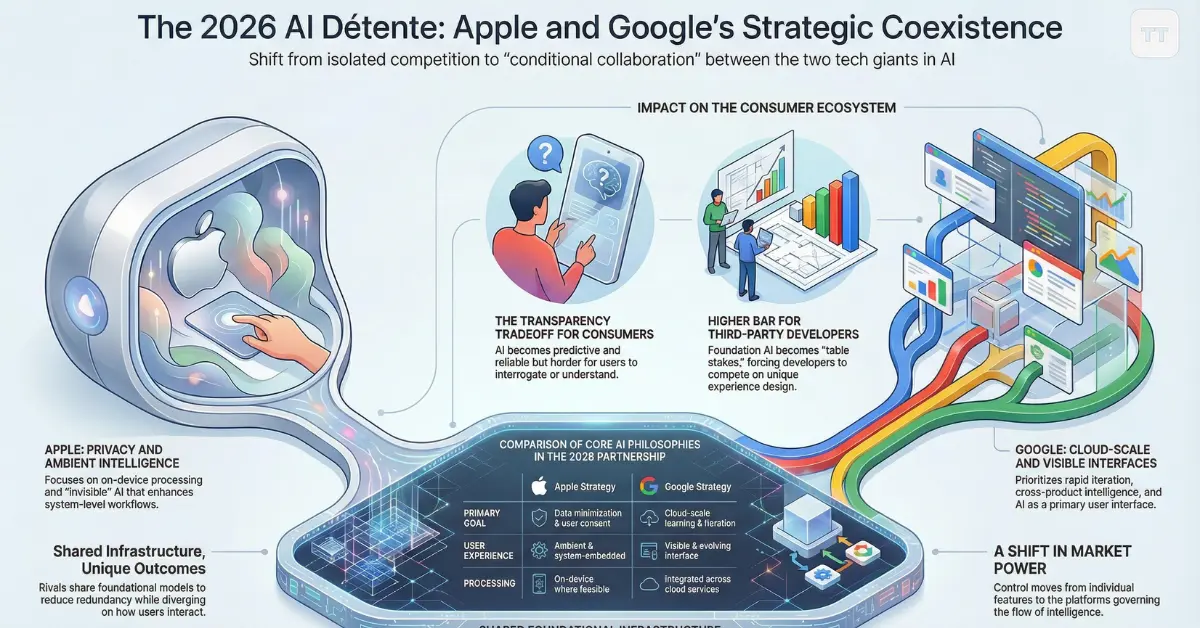
Apple’s AI strategy in 2026 continues to emphasize:
- On-device processing where feasible
- Data minimization and user consent boundaries
- AI as a system-level enhancer rather than a destination
Google’s approach still prioritizes:
- Cloud-scale learning and rapid iteration
- Cross-product intelligence spanning search, productivity, and media
- AI as a visible, evolving interface
The partnership does not blur these philosophies; it exploits their compatibility. Apple can integrate external generative intelligence without owning massive data pipelines. Google can extend its AI influence into environments where it lacks hardware control. Each benefits without ideological compromise.
This distinction matters for developers and IT decision-makers, because it determines where innovation friction appears—and where it does not.
What Developers Gain—and What They Lose
For developers, the collaboration introduces both opportunity and constraint.
On the positive side, shared standards and interoperable AI components reduce fragmentation. Developers targeting both iOS and Android in 2026 face fewer conceptual mismatches when implementing generative features, conversational interfaces, or contextual intelligence. Tooling feels more consistent, even if APIs remain platform-specific.
However, there is a tradeoff that is rarely acknowledged. As Apple and Google align on foundational AI capabilities, differentiation shifts upward. Developers are expected to compete on experience design, trust, and use-case specificity rather than raw model performance. This raises the bar for product thinking while reducing the payoff for superficial AI integration.
In practical terms, AI becomes table stakes. The partnership accelerates that reality.
The Consumer Experience: Smarter, Calmer, and Less Transparent
From a consumer perspective, the most noticeable change is subtlety.
AI in 2026 is less about novelty and more about anticipation. Devices infer intent, summarize information, and assist with tasks without requiring explicit prompts. The Apple–Google alignment supports this by improving reliability and reducing edge-case failures that frustrate users.
Yet this smoothness comes at the cost of transparency. Users often cannot tell which system made a decision, which model generated a response, or where processing occurred. For privacy-conscious audiences, this ambiguity can feel unsettling—even if safeguards are in place.
This tension represents a core misconception: better AI does not always feel more empowering. Sometimes it feels quieter, more automatic, and harder to interrogate.
AI Ecosystem Partnerships and the New Power Structure
The Apple–Google AI partnership is not an isolated event; it is part of a broader trend toward ecosystem-level alliances among big tech firms.
In 2026, AI ecosystem partnerships are increasingly shaped by:
- Regulatory pressure to demonstrate responsibility
- Economic incentives to share foundational costs
- Strategic interest in influencing standards rather than owning everything
What changes is where power accumulates. Control shifts from individual features to platforms that define how intelligence flows across devices, apps, and services. Apple and Google are positioning themselves as governors of this layer, even when collaborating.
This reframes competition. The question is no longer who has the best model, but who defines the rules under which models operate.
An Overlooked Limitation: Innovation Speed vs Stability
One limitation rarely discussed is how collaboration affects innovation velocity.
Partnerships introduce coordination overhead. Aligning safety standards, interoperability requirements, and release timelines can slow experimentation. While this increases stability for consumers and enterprises, it may reduce the frequency of radical shifts.
For cutting-edge use cases, especially in creative or experimental domains, this could push innovation to smaller players and startups operating outside major ecosystems. In that sense, the Apple–Google collaboration stabilizes the center while energizing the edges.
This is not inherently negative, but it reshapes where breakthroughs are likely to emerge.
Who This New AI Landscape Is Best For—and Who It Isn’t
This evolving partnership is particularly beneficial for:
- Consumers who value reliability over customization
- Enterprises seeking predictable AI behavior across platforms
- Developers building cross-platform products with long lifecycles
It is less ideal for:
- Users who want deep control over AI decision-making
- Developers relying on platform-specific quirks for differentiation
- Organizations pushing highly experimental or unconventional AI interactions
Recognizing this helps stakeholders choose tools and strategies aligned with their goals rather than chasing perceived industry momentum.
Frequently Asked Questions
Is Apple and Google’s AI collaboration a merger of their AI systems?
No. The collaboration focuses on selective integration and shared capabilities, not a unified AI platform. Each company maintains independent models, policies, and strategic control.
Does this partnership reduce competition between iOS and Android?
Competition remains strong at the experience and ecosystem level. The partnership mainly reduces redundancy in foundational AI capabilities rather than differentiating features.
Will user data be shared between Apple and Google through AI features?
There is no indication of direct data sharing. Both companies continue to enforce distinct privacy and data-handling frameworks within their respective platforms.
How does this affect third-party AI apps?
Third-party apps benefit from more stable system-level intelligence but face higher expectations for meaningful differentiation beyond basic AI functionality.
Is this collaboration permanent?
It is best viewed as adaptive rather than permanent. The scope and depth are likely to evolve based on regulation, market dynamics, and technological shifts.
Conclusion: A Partnership That Redefines the Middle Ground
The Apple–Google AI partnership in 2026 is not about convergence—it is about coexistence at scale. By collaborating where it reduces friction and competing where it preserves identity, both companies are reshaping how consumer AI evolves.
The real significance lies in what this enables: calmer interfaces, more dependable intelligence, and a rebalanced innovation ecosystem. For users and decision-makers alike, the takeaway is not who is winning, but how the rules of engagement have changed.
As AI becomes less visible and more foundational, understanding these partnerships becomes essential—not to predict features, but to anticipate where influence, control, and opportunity will reside next.