Quantum vs. AI: The Future of Tech Supremacy might sound like a technical battle for a distant future, but beneath the surface lies a powerful secret. With the right perspective, you can understand how this partnership will redefine our world in the next decade—and most people don’t even realize it’s not a fight at all.
You’ve probably felt it. That little jolt of wonder (and maybe unease) when you ask an AI like ChatGPT to write a poem, and it actually does. Or when your streaming service knows what movie you want to watch before you do. That’s AI computing, and it’s already changing our lives. It feels like magic.
But here’s the problem: this “magic” is about to hit a hard wall.
The kinds of problems we really need to solve—like curing Alzheimer’s, creating room-temperature superconductors, or stopping climate change—are so monstrously complex that even the biggest AI supercomputers would take thousands of years to even start.
This is where quantum computing enters the room.
We’re told to think of this as a showdown: Quantum vs. AI. The next great tech battle. But I’m going to let you in on the truth, as someone who has spent over a decade separating the hype from the reality in this space: that’s completely wrong.
Asking if quantum will beat AI is like asking if a jet engine will beat a pilot.
It’s the wrong question. The real question is what happens when you put the jet engine in the pilot’s plane. This isn’t a story about a “versus.” It’s a story about a “plus.”
Here’s what you’ll discover:
- Why “AI Computing” as you know it is hitting a fundamental limit.
- What quantum computing actually is, explained in simple analogies.
- The “Big Misconception” that pits these two technologies against each other.
- How quantum will supercharge AI to solve problems we thought were impossible.
- Who really wins the race for “tech supremacy.”
First, What Are We Really Talking About with AI?
Before we get to the quantum future, let’s be clear about the AI present.
When we say “AI” or “AI computing” right now, we’re almost always talking about a specific field called machine learning running on our current computers (which we call “classical” computers).
AI Isn’t a Robot Butler (Yet)
Forget The Terminator. Today’s AI is not a conscious being. It’s a hyper-advanced pattern-matching system.
You feed it a mountain of data (like every picture of a cat on the internet), and it “learns” to recognize the pattern of a cat. It doesn’t “know” what a cat is. It doesn’t “understand” fluffiness or whiskers. It just knows that a specific arrangement of pixels is, with 99.8% probability, a “cat.”
The “Brain” Behind the Buzz: Machine Learning & Neural Networks
This “learning” happens in a structure called a neural network, which is a system loosely inspired by the human brain. It’s made of digital “neurons” that fire and wire together as they process data, getting progressively better at their one specific task.
This is incredibly powerful for:
- Recognizing your voice (Siri, Alexa).
- Predicting what you’ll type next (your phone’s keyboard).
- Generating text or images (ChatGPT, Midjourney).
The Big Problem AI Is Facing Right Now
Today’s AI runs on classical computers. These computers are built on a simple, 70-year-old idea: the “bit.”
A bit is a tiny switch. It can be either a 0 (off) or a 1 (on). That’s it.
This binary system is fantastic for most things. But when an AI tries to solve a truly complex problem—like modeling all the possible interactions of molecules for a new drug—the number of potential combinations explodes.
Trying to find the single best molecular design is like trying to find one specific grain of sand on every beach on Earth. A classical computer, even a supercomputer, has to check them one by one. It’s just too slow. The AI’s “brain” is willing, but its “muscles” (the classical computer) are just not built for the job.
And What in the World is Quantum Computing?
This is where quantum computing changes the game. It’s not just a faster version of your laptop; it’s a completely new kind of computer.
It’s so different that it feels like science fiction. But I promise, the basic idea is something you can grasp.
It’s Not Just a Faster Computer (It’s a Different Computer)
While a classical computer uses “bits” (0 OR 1), a quantum computer uses “qubits.”
And this is the mind-bending part: a qubit doesn’t have to be just a 0 or a 1. It can be both at the same time.
This is a real property of the universe at a subatomic level, and it’s called superposition.
- Analogy: Think of a classical bit as a light switch. It’s either off (0) or on (1).
- A qubit is like a dimmer switch. It can be off (0), on (1), or anywhere in between (30% on, 70% off) all at once.
This one change means a quantum computer can explore millions of possibilities simultaneously. While a classical computer checks one grain of sand at a time, a quantum computer can check all the beaches at once.
The “Magic” Tricks: Superposition and Entanglement
Superposition is the first trick. The second is entanglement.
You can link two qubits together. When you do, they become “entangled.” Whatever happens to one instantly influences the other, no matter how far apart they are. Albert Einstein famously called this “spooky action at a distance.”
By using superposition and entanglement, a quantum computer doesn’t just calculate; it orchestrates a complex harmony of probabilities. It’s a machine built to understand and compute the native language of reality: quantum mechanics.
The Big Misconception: Why “Quantum vs. AI” Is the Wrong Question
This brings us back to the main topic: Quantum vs. AI.
The reason this comparison makes no sense is that they aren’t in the same category.
It’s a “Hardware vs. Software” confusion.
AI (specifically, machine learning) is a process, an algorithm, a type of software.
Quantum computing is a machine, a new type of hardware.
You can’t have “AI vs. Quantum” any more than you can have “Microsoft Excel vs. an Intel Processor.” They are designed to work together.
Where Did This “Battle for Supremacy” Idea Come From?
The confusion is understandable. The race for tech supremacy is real. Nations and corporations are pouring billions ofDallars into both fields.
This has created a media narrative of two titans racing for the finish line. But in the labs at Google, IBM, and top universities, these teams aren’t competing. They’re collaborating.
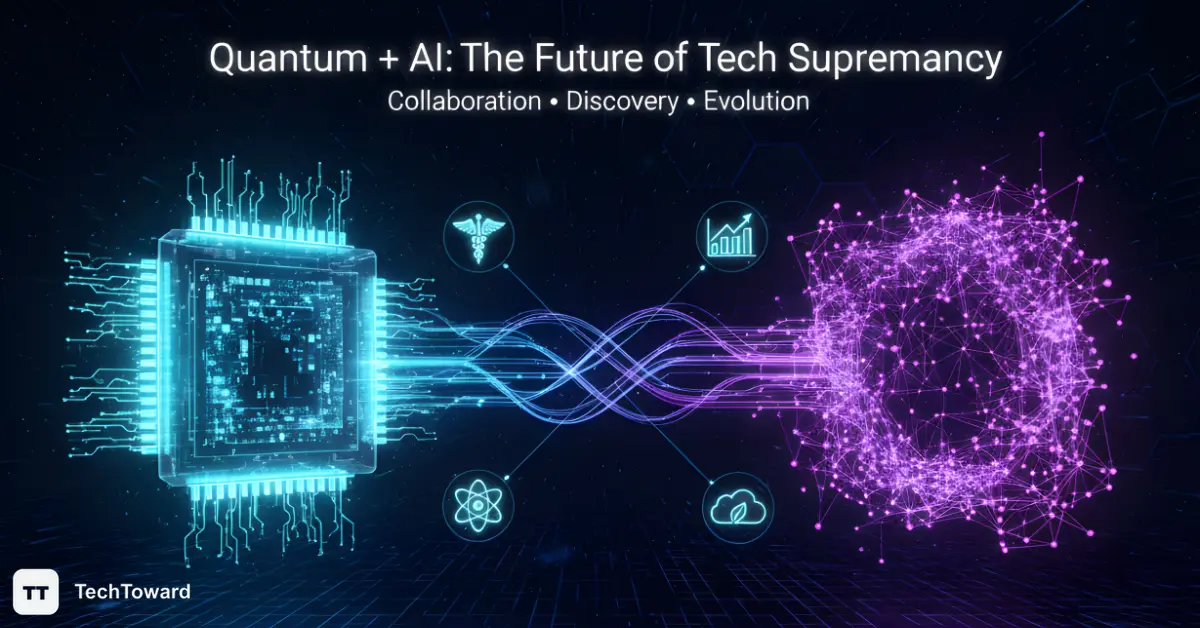
The real race isn’t to build the best AI or the best quantum computer. It’s to be the first to build the best quantum-powered AI.
The Real Story: How Quantum Supercharges AI (Not Fights It)
This is the future. This is the revolution. When you combine the pattern-finding genius of AI with the raw combinatorial power of quantum, you unlock a new class of problem-solving.
This new field is called Quantum-Enhanced AI (QAI) or Quantum Machine Learning (QML).
It’s not about replacing all AI. Your phone’s keyboard will still run on classical AI. This is about tackling the “impossible” problems.
Example 1: Discovering New Medicines in Days, Not Decades
The Problem: Designing a new drug means finding a molecule that will perfectly bind to a specific protein in a virus or disease. The number of possible molecule shapes is astronomical.
Classical AI: Can guess and check a few million options, but it’s mostly blind.
Quantum-Enhanced AI: A quantum computer can simulate exactly how molecules behave at the quantum level. The AI can then use this perfect simulation to design the exact key to fit the “lock” of a disease. This is closely related to the work being done to create personalized cancer treatments.
Example 2: Building AI That Truly Understands Finance
The Problem: Financial markets are a storm of interconnected variables. Predicting a crash or finding the perfect investment portfolio is beyond any human or classical AI.
Classical AI: Can spot simple trends but gets overwhelmed by the chaos.
Quantum-Enhanced AI: Quantum computers are born to find the optimal path through chaos. A QAI could analyze trillions of data points in real-time to find hidden patterns, detect fraud instantly, and manage risk with a precision we can’t even imagine.
Example 3: Solving Our Climate and Energy Crisis
The Problem: We need new materials. We need a catalyst to pull carbon from the air efficiently. We need a material for a room-temperature superconductor that would enable 100% efficient power grids.
Classical AI: Can’t simulate the quantum physics required to “invent” a new material from scratch.
Quantum-Enhanced AI: A QAI can. It can model and test billions of new material combinations at the subatomic level until it finds one with the exact properties we need. This is how we invent our way to a cleaner future.
So, Who Actually Wins the Race for Tech Supremacy?
If it’s not “Quantum vs. AI,” then who wins the “tech supremacy” prize?
The answer is simple: Whoever masters the integration of the two.
It’s Not a Single Company, It’s a New Era
The nation or consortium of companies that cracks practical, large-scale Quantum-Enhanced AI will lead the 21st century. Period.
This isn’t just about a faster computer. It’s about a fundamental shift in economic, scientific, and even military power. According to researchers at leading institutions like NIST (the U.S. National Institute of Standards and Technology), the race to build a fault-tolerant quantum computer is a national priority for this very reason.
It’s an “industrial revolution” level of change.
The Risks: What If We Get This Wrong?
This power also comes with massive risks. One of the first things a powerful quantum computer will be able to do is break encryption.
Almost all the data that keeps our modern world secure—our bank accounts, our state secrets, our private messages—is protected by math that is too hard for classical computers to solve.
A quantum computer could potentially crack it in hours.
This is the “quantum apocalypse” you might have heard about. The only way to fight a quantum attack is to create new “quantum-proof” encryption. And what’s the best tool for designing that new, complex security? You guessed it: a quantum-powered AI.
What This Means for You (Even If You’re Not a Tech CEO)
This all sounds huge and abstract, but this “tech supremacy” race will ripple down and change your life directly.
- Your Health: Imagine your doctor taking a sample of your DNA and using a QAI to design a medicine just for you that attacks your specific illness with zero side effects.
- Your Finances: A financial system that is virtually immune to the kind of catastrophic crashes that wipe out savings, all because QAI can see the risks and adapt in real-time.
- Your Data: A new, unhackable internet. Or, in a darker future, a world with no digital privacy at all.
This is what’s at stake. This is why understanding that it’s “Quantum and AI” is so critical.
Frequently Asked Questions (The Quick Answers)
Let’s clear up a few common points of confusion.
Is quantum computing a type of AI?
Here’s the short answer: No, quantum computing is a fundamentally new type of hardware (a computer), while AI is a broad field of software and algorithms.
And the reason it matters is this: Think of quantum computing as the engine and AI as the driver. The new engine allows the driver to go places they never could before.
Will quantum computing replace AI?
Here’s the short answer: No, quite the opposite; quantum computing will dramatically accelerate and expand what AI can do.
Most people think it’s a replacement, but it’s an accelerator. It won’t replace AI any more than a high-end graphics card (GPU) “replaced” video games—it just made them infinitely more powerful and realistic.
What is the main difference between quantum and AI computing?
Here’s the short answer: The main difference is that “AI computing” (as we know it) runs on classical bits (0s or 1s), while quantum computing runs on qubits (0, 1, or both at once).
This unique property allows quantum machines to explore a vast number of possibilities simultaneously, a task that would take today’s AI supercomputers thousands of years.
Which is more powerful, AI or quantum?
Here’s the short answer: This is like asking if a brain or a hammer is more powerful—they are different tools for different jobs.
Here’s the truth: AI is “powerful” at learning from data and making predictions. Quantum computing is “powerful” at solving incredibly complex calculations. The most powerful future is combining them.
When will quantum AI be available?
Here’s the short answer: Simple forms of quantum-assisted AI are being researched right now, but a widely available, powerful “quantum AI” is likely still 5-10 years away or more.
But don’t be mistaken—the “quantum-ready” era has already begun. Companies are already designing AI algorithms that will be “plug-and-play” ready the moment the quantum hardware is stable enough.
The Final Takeaway: It’s Not a Duel, It’s a Revolution
So, Quantum vs. AI was never the real story. The tech press loves a good fight, but the truth is far more exciting.
This isn’t a battle. It’s the most important collaboration in the history of technology.
We are at the very beginning of a new age of computation, one where the “magical” pattern-matching of AI is fused with the universe-level power of quantum mechanics. This combination won’t just make our computers faster; it will give us a new set of eyes to see the world, a new way to solve problems we’ve long given up on.
Now that you know the real story behind quantum and AI, the “vs.” is over.
The partnership is just beginning. Don’t just watch the future happen—understand it.