Summary
The reported $692M compensation package awarded to Sundar Pichai reflects far more than a traditional salary increase. It represents a long-term leadership incentive structure designed by Alphabet Inc. to align executive decision-making with shareholder value, stock performance, and strategic stability during a highly competitive era of artificial intelligence and platform dominance.
Rather than immediate cash earnings, most of the package consists of performance-based equity tied to multi-year milestones, meaning the actual realized value depends heavily on the future performance of Google and its broader ecosystem.
A Compensation Headline That Looks Shocking—But Tells a Deeper Story
When headlines reported that Sundar Pichai received a $692M pay package, the number immediately sparked debate across the technology industry, financial media, and corporate governance circles. To many observers, the figure appears extraordinary—even excessive.
Yet the reality behind modern executive compensation is more nuanced.
In large technology companies, pay announcements rarely represent immediate earnings. Instead, they reflect long-term equity grants designed to guide strategic leadership decisions for many years into the future. These packages are structured to reward outcomes that strengthen company value rather than simply compensate short-term performance.
The timing of this particular award also matters. The technology industry is entering one of its most consequential transitions in decades, driven by artificial intelligence infrastructure, platform competition, and global regulatory scrutiny. For a company the scale of Alphabet, leadership continuity during this period carries enormous financial implications.
What many discussions miss is that the package reveals as much about Big Tech’s evolving leadership strategy as it does about one executive’s pay.
Understanding the Structure Behind the $692M Figure
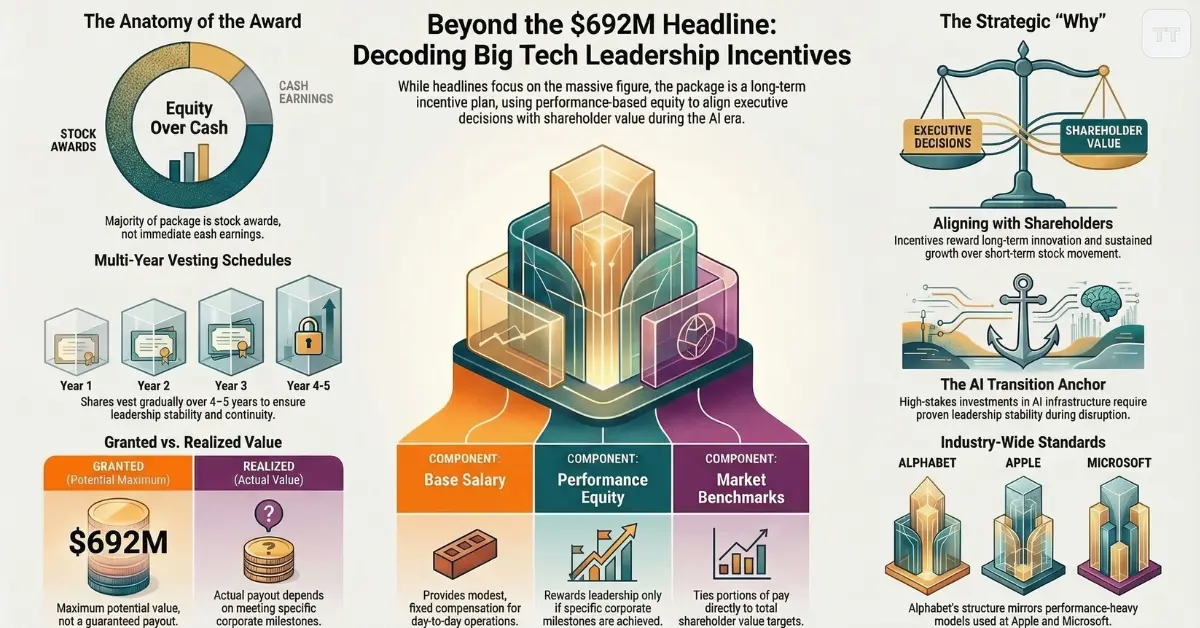
Large compensation numbers often create the impression of immediate payout. In reality, the majority of executive packages consist of stock-based incentives that vest gradually over several years.
In this case, the package tied to Pichai’s role as CEO of Alphabet includes several key components commonly used in modern executive compensation design.
First is base salary, which represents a relatively small portion of total compensation. At large technology firms, salaries for top executives typically remain modest compared to stock awards.
The much larger portion comes from performance-based equity grants, which can include restricted stock units (RSUs) and other stock incentives tied to corporate milestones. These grants typically vest in stages over multiple years, ensuring that leadership remains focused on sustained growth rather than short-term stock movement.
Another layer involves performance thresholds linked to market outcomes, meaning portions of the equity only vest if the company achieves specific shareholder value targets or financial benchmarks.
This structure transforms executive compensation into a long-term partnership with shareholders, where leadership rewards depend heavily on company performance.
For observers unfamiliar with corporate governance mechanics, the difference between “granted value” and “realized value” is critical. The headline number represents the maximum potential value of stock grants at the time of award—not guaranteed income.
Why Alphabet Uses Large Equity Packages for Leadership Incentives
Technology companies often rely on equity-heavy compensation structures because their value is closely tied to innovation cycles and long-term platform dominance.
For a company like Alphabet, the leadership role extends far beyond day-to-day operations. Strategic decisions can influence billions of users and reshape entire industries—from cloud infrastructure to digital advertising to artificial intelligence.
Equity incentives serve several purposes simultaneously:
- They tie executive rewards directly to shareholder value
• They encourage leaders to prioritize long-term innovation over short-term gains
• They reduce the need for excessive cash compensation
• They reinforce leadership stability during periods of industry disruption
In effect, stock-based compensation transforms the CEO into one of the company’s most invested stakeholders.
This alignment becomes especially important in an era where companies are spending tens of billions of dollars on emerging technologies such as AI infrastructure and semiconductor partnerships.
The AI Era Is Raising the Stakes for Big Tech Leadership
One reason the scale of executive compensation is increasing across the industry is the rising importance of strategic technological bets.
Artificial intelligence development alone is expected to reshape nearly every major technology platform. Companies are investing heavily in large-scale data infrastructure, custom silicon, and global cloud networks to support AI services.
For Alphabet, this includes major initiatives across its ecosystem—from AI-powered search experiences to enterprise cloud services.
Leadership during this transition requires balancing several competing priorities simultaneously:
- maintaining profitable core businesses
• funding long-term innovation programs
• navigating global regulatory pressure
• competing with other technology giants in AI infrastructure
The scale of these decisions explains why boards increasingly design multi-year compensation packages intended to anchor leadership during strategic transitions.
Replacing a CEO during such a critical period can introduce instability that costs companies far more than the compensation required to retain proven leadership.
Comparing Big Tech CEO Pay in 2026
The scale of compensation packages across the technology sector has steadily increased over the past decade, though the structure often differs significantly between companies.
For example, Tim Cook, who leads Apple Inc., also receives a substantial portion of compensation through stock incentives tied to company performance and market value targets.
Similarly, Satya Nadella at Microsoft operates under a compensation framework that heavily emphasizes stock performance metrics and long-term value creation.
Across the industry, several patterns are visible in modern executive pay structures:
- Equity compensation now dominates executive pay packages
• Vesting periods often extend four to five years
• Performance benchmarks increasingly include shareholder return metrics
• Boards design packages to discourage short-term risk-taking
In other words, Big Tech compensation is less about immediate income and more about strategic alignment between leadership and long-term company performance.
A Frequently Overlooked Detail: Vesting Schedules
One aspect often overlooked in public discussions is the stock award vesting schedule.
Even though a grant may be valued at hundreds of millions of dollars, the shares typically vest gradually. This means the executive must remain with the company and achieve performance milestones over several years before the full value can be realized.
If leadership changes prematurely or company performance declines significantly, large portions of the award may never fully materialize.
This design effectively converts compensation into a multi-year performance contract rather than an upfront reward.
For companies like Alphabet, which operate long product development cycles, this structure encourages leadership stability across major innovation programs.
The Corporate Governance Debate Around Executive Pay
Despite the strategic logic behind stock-based compensation, large executive packages often trigger debates about corporate governance and fairness.
Critics sometimes argue that such compensation reflects excessive executive privilege. Supporters counter that technology CEOs oversee companies worth trillions of dollars and influence global infrastructure used by billions of people.
In governance terms, the key question is not simply how large the compensation package appears, but whether the incentives truly align with shareholder interests.
A well-structured executive compensation plan typically meets several governance principles:
- performance metrics must be transparent
• incentives must reward long-term value creation
• boards must maintain independence in pay decisions
• shareholders must have advisory input on compensation policies
Alphabet’s approach reflects a broader industry effort to tie executive rewards more tightly to measurable outcomes rather than guaranteed pay.
What This Pay Package Signals About Alphabet’s Strategy
Beyond compensation mechanics, the scale of the package also reveals the board’s confidence in the company’s strategic direction.
Alphabet currently operates across several high-stakes technology sectors, including:
- artificial intelligence platforms
• cloud computing infrastructure
• global digital advertising
• autonomous driving research
• hardware ecosystems
Managing this portfolio requires balancing profitable legacy businesses with experimental innovation programs that may take years to mature.
The compensation package signals that Alphabet’s board views leadership continuity as a key factor in navigating this complexity.
It also reflects the belief that the company’s next decade of growth will depend heavily on the strategic decisions made today.
The Tradeoffs Behind Massive Executive Pay
Large compensation packages are rarely without tradeoffs.
On one hand, they can help retain experienced leadership capable of guiding complex global companies. On the other, they risk attracting criticism if shareholders perceive the rewards as disconnected from company performance.
This tension explains why modern executive compensation increasingly relies on performance-based equity structures rather than guaranteed pay.
If a company succeeds, executives share in the value created. If performance stagnates, the theoretical value of stock-based compensation declines accordingly.
In this sense, the structure attempts to balance executive motivation with shareholder accountability.
Why the Headline Number Can Be Misleading
A key insight often overlooked in discussions about executive pay is that grant value and realized value are not the same.
The $692M figure represents the estimated value of stock awards at the time they are granted. However, several variables determine what portion of that value may eventually be realized:
- stock market performance over multiple years
• achievement of internal performance targets
• continued employment during the vesting period
• macroeconomic conditions affecting the technology sector
If the company’s stock price rises significantly during the vesting period, the realized value could exceed the original estimate. If performance declines, the final value could be much lower.
Understanding this dynamic is essential when evaluating compensation headlines.
What the Package Means for the Future of Big Tech Leadership
The scale and structure of modern executive pay packages reveal broader shifts in how technology companies think about leadership.
Several trends are becoming increasingly clear across the industry.
First, long-term equity incentives are replacing traditional salary-focused compensation models.
Second, companies are designing leadership incentives that stretch across multiple product cycles rather than annual performance reviews.
Third, boards are increasingly using compensation structures to anchor leadership during major technology transitions, particularly the shift toward AI-driven platforms.
In this context, the $692M compensation package awarded to Sundar Pichai is less an isolated event and more a reflection of evolving leadership economics within the global technology sector.
People Also Read : Top 3 Richest Tech Giants in the World and Their Net Worth
FAQ
Why did Sundar Pichai receive a $692M pay package?
The package primarily consists of long-term stock awards designed to align leadership incentives with shareholder value. The full amount depends on company performance and multi-year vesting schedules rather than immediate salary payments.
How much does the Google CEO actually earn each year?
The CEO receives a relatively modest base salary compared to the total compensation package. Most earnings come from equity grants that vest gradually over several years.
Is this the largest executive compensation package in Big Tech?
It is among the largest headline figures, but comparable technology leaders also receive substantial stock-based incentives tied to company performance and market value growth.
Why do tech companies rely heavily on stock-based compensation?
Equity compensation aligns executive rewards with company performance. If the business grows and shareholder value increases, executives benefit alongside investors.
Could the CEO actually receive the full $692M?
Only if the company meets the required performance targets and the executive remains in position throughout the vesting period. If conditions change, the realized value could be significantly lower.
How does this compare to other tech CEO compensation?
Leaders across major technology companies receive compensation structures dominated by equity incentives. The scale varies depending on company size, growth potential, and performance metrics.
Conclusion
The $692M compensation package awarded to Sundar Pichai is not simply a dramatic headline about executive pay. It represents a strategic leadership contract shaped by the realities of modern technology companies.
In an industry where a single decision can influence global markets, infrastructure, and billions of users, boards increasingly design compensation systems that bind leadership incentives to long-term performance.
What the package ultimately reveals is not just how much a CEO might earn, but how deeply the future of the company is tied to the decisions made at the top.
As artificial intelligence and global technology competition accelerate, leadership stability has become a strategic asset. For companies like Alphabet, compensation structures are increasingly designed with that reality in mind.