Summary
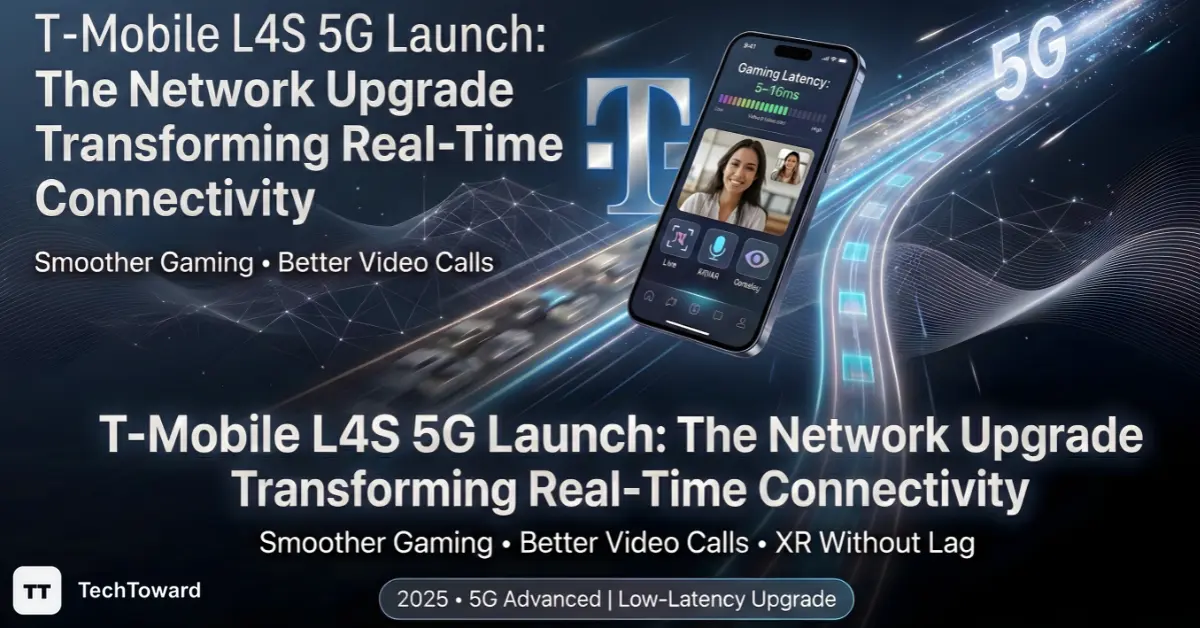
What if your mobile gaming got as smooth as a console — even when everyone around you is online? With T-Mobile’s new L4S on 5G Advanced, lag, stutter, and frozen video calls could become things of the past. Read on to find out how this quiet network upgrade is transforming gaming, video calls, XR, remote driving — and could change everyday connectivity forever.
Why This Quiet Network Revolution Matters More Than You Think
Have you ever joined a video call only to see someone’s face freeze mid-sentence — or experienced that frustrating moment in a mobile game when your character refuses to respond even though you tapped the screen three times? These aren’t just annoying glitches. They’re symptoms of a deeper problem in wireless networks: congestion and latency.
With T-Mobile’s new rollout of L4S on their 5G Advanced network, the company is solving a problem that many users have silently accepted for years. What this means is: gaming, video calls, virtual reality — anything that depends on real-time communication — can finally feel smooth, responsive, and reliable.
In this article you’ll discover:
-
What exactly is L4S and why it matters.
-
How T-Mobile implemented it and what sets them apart.
-
Real-world benefits for everyday users (gaming, video calls, AR/XR).
-
Broader implications — for businesses, enterprise, remote-driving, and future tech.
-
What to check now to know if you’re benefiting from it.
-
FAQs and myth-busting.
Let’s dive in.
What Is L4S — and Why Should You Care?
📡 Understand the Tech: Low Latency, Low Loss, Scalable Throughput
L4S stands for Low Latency, Low Loss, Scalable Throughput. In simple terms, it’s a network protocol designed to make data — especially time-sensitive data — travel smoothly, even when the network is busy. Instead of treating all data equally (like a congested road where every vehicle slows down), L4S gives “express-lane” priority to data that needs to arrive fast — like your voice in a video call, or your control signal in a game.
This is a big shift from traditional congestion control methods. Those older methods often only look at data after congestion has already happened, resulting in delays or packet loss. L4S, by contrast, marks packets early when there is congestion, and lets devices adapt dynamically — reducing lag, jitter, or stutter before they become noticeable.
In short: think of regular network traffic as a crowded highway. L4S builds optimised “express lanes” for critical traffic (gaming inputs, voice/video, XR) so your data gets where it needs to be fast, even when everyone else is stuck.
Why Wireless L4S Is a Big Deal — And Why It Was Hard
L4S isn’t new. Wired networks (like fiber ISPs) have supported L4S-style protocols before. But rolling it out over a wireless 5G network — at scale — is unprecedented. That’s because wireless networks historically have more complexity (mobility, interference, varying signal strength), making reliable low-latency hard to guarantee.
With its nationwide rollout, T-Mobile becomes the first carrier in the U.S. to offer L4S over a wireless 5G network.
What made it possible? Two major factors:
-
Standalone 5G Core (5G SA) Infrastructure — T-Mobile built its 5G network from the ground up, without piggybacking on older 4G/LTE cores. That clean, modern architecture allows it to support advanced features like L4S at scale.
-
5G Advanced Software & AI-Assisted Network Management — As part of its “5G Advanced” upgrade, T-Mobile uses AI/ML in the radio access network (RAN) and core to dynamically allocate resources, manage congestion, and optimise performance across multiple use cases (video, gaming, IoT, XR, etc.).
In combination, this network-first approach — not a “faster-speed” marketing ploy — is what allows low-latency wireless communication to become a reality.
How T-Mobile’s L4S Launch Changes Daily Digital Life
You don’t need to be a tech expert to benefit. Here’s how ordinary users (and more) are likely to notice improvement — sometimes without knowing why.
🎮 Gaming Gets Seriously Competitive
For years, mobile gamers accepted that wireless gaming might never feel as responsive as console or PC gaming. But with L4S, that changes.
-
Cloud-gaming services such as GeForce NOW have already added support for L4S — meaning lower lag and less packet loss even if the network is congested.
-
In highly competitive or fast-paced games, milliseconds matter. With L4S, your taps and swipes reach servers with minimal delay, reducing jitter and making gameplay feel smooth — more like a wired experience.
-
Even when other nearby users are hogging bandwidth, L4S ensures your gameplay remains stable.
If you’re a gamer — whether casual or competitive — this shift could make a noticeable difference in responsiveness and overall experience.
📞 Video Calls and Remote Work: Finally Smooth & Reliable
Video calls are easier than ever to mess up. Busy networks, congestion, heavy data — all cause frozen video, choppy audio, or weird delays. L4S helps fix that.
-
L4S dynamically adjusts for congestion, reducing stutters, frozen frames, and audio issues in video calls or conferencing.
-
Whether you’re in a crowded airport, a busy cafe, or a house with multiple connected devices — L4S helps maintain stable and smooth calls.
-
For remote work, education, telehealth, family calls — this means fewer disruptions and more reliable performance.
🥽 Extended Reality (XR), AR, and Future Tech: Now More Realistic
Immersive technologies such as XR/AR have long promised to change how we work, learn, and play — but latency and jitter have held them back.
-
In March 2025, Ericsson, Qualcomm Technologies, and T-Mobile began trials using slim AR glasses connected over 5G SA with L4S. Results reportedly included “crystal-clear visuals, ultra-smooth frame delivery,” and significantly reduced motion sickness or dizziness.
-
That’s huge — smooth visuals + low latency = comfortable XR sessions, better AR apps, and more realistic immersive experiences.
-
As XR/AR headsets and wearables become more widespread, L4S could help bring them into mainstream everyday use.
🚗 Remote Driving, Cloud-based Logistics, and Enterprise
It’s not just about games and calls. L4S could also enable high-stakes, professional real-time applications.
-
T-Mobile reportedly partnered with a remote-driving firm (Vay) to test remote-driving over 5G SA + L4S. Even under congested network conditions, drivers experienced predictable, consistent latency — to the point that operators said it “felt like they were physically in the car.”
-
For industries like logistics, smart mobility, tele-operations (e.g. remote forklifts, drones, robots), and connected-vehicle fleets, this low-latency wireless connection can be transformational.
-
Beyond that, stable low-latency connectivity helps sectors like remote monitoring, telemedicine, smart-city infrastructure — any application where real-time data transfer matters.
What Made This Possible: The Technical & Infrastructure Foundation
Understanding why T-Mobile’s L4S works helps you appreciate that this isn’t just a marketing gimmick.
-
As of April 2025, T-Mobile attained a major milestone: its 5G Advanced network is nationwide. This means that 5G Advanced — with features like L4S — is available broadly across the U.S.
-
5G Advanced blends the latest standards from the global telecom standard body (3GPP) — especially Release 18 and elements of Release 17 — with custom optimizations. These include AI and ML enhancements at the RAN and core level for dynamic resource allocation, latency reduction, throughput stabilization, and energy efficiency.
-
Because T-Mobile built a standalone 5G core (5G SA) from the start — instead of relying on legacy 4G infrastructure — it has the flexibility needed to deploy advanced features like L4S, network-slicing, and other programmable network capabilities at scale.
In other words: this isn’t just “a bit faster internet”. This is a re-architected network — designed for the future of real-time, interactive, cloud-based connectivity.
What This Means for Business, Enterprise & the Future of Connectivity
The release of L4S over wireless 5G is not only good for gamers or casual users — it’s a potential game-changer for business and enterprise.
-
With programmable features like L4S and network slicing, T-Mobile can offer differentiated, custom network “lanes” — for example, a slice dedicated to a factory robot network, another for emergency services, and yet another for consumer mobile phones. This segmentation allows providers to guarantee performance levels for critical use cases.
-
For enterprises and developers, this unlocks new use cases: remote monitoring, industrial IoT, tele-medicine, AR/VR collaboration, smart-city systems, vehicle fleets, and more.
-
The combination of low latency, stable throughput, AI-powered network management, and 5G SA architecture positions the network to support next-generation applications — even setting groundwork for future technologies and possibly next-generation standards beyond 5G.
What You — As a User — Should Know Right Now
✅ There’s Usually Nothing You Need to Do
Good news: you probably don’t need to do anything special to benefit. The changes occur at the network level. As long as you’re on T-Mobile’s 5G Advanced network, experience should improve automatically.
🔧 Device & Coverage Matter
That said — for the best results:
-
Make sure you’re in an area covered by T-Mobile’s 5G Advanced / L4S rollout (coverage is expanding).
-
Newer devices — or devices that get firmware updates — are more likely to fully support L4S. If your device is older, or doesn’t support 5G SA properly, you may not get the full benefits.
👀 What You Might Notice Immediately
Once you’re on the right network and device:
-
Video calls will feel smoother, with fewer freezes or glitches — even when many people around are online.
-
Cloud gaming / mobile gaming will feel more responsive, with less lag, less jitter, smoother movements.
-
If you use XR/AR devices — or plan to — visuals and frame stability should be significantly better (less nausea or stutter).
-
For remote-work apps, live collaboration tools, or remote-control systems — latency and reliability will improve noticeably.
📲 Keep an Eye on Updates & Announcements
Because L4S support depends partly on device firmware and partly on carrier rollout, stay alert for:
-
System / OS updates on your phone (which might add or improve L4S support).
-
Announcements from T-Mobile about 5G Advanced coverage expansion.
-
Device vendors releasing new 5G-capable hardware (phones, routers, XR headsets).
Debunking Common Myths & Misconceptions
| Myth / Concern | Reality |
|---|---|
| “L4S will dramatically boost my download speed.” | Not true. L4S is about latency and stability, not raw speed. Speed tests won’t necessarily show a big difference, but real-time apps will feel much more responsive. |
| “I need a special device or plan for L4S.” | No. The upgrade is at the network level; most improvements are automatic. But newer or 5G-capable devices maximize the benefits. |
| “This only helps gamers.” | Not at all. Gaming is just one visible case. Video calls, XR/AR streaming, remote operations, cloud services — many areas benefit equally. |
| “L4S is future tech — not for today.” | It’s already live. T-Mobile started rolling out L4S broadly in 2025. |
The Bigger Picture: What’s Next & Why This Matters for Everyone
With L4S over a nationwide 5G Advanced network, T-Mobile isn’t just improving internet for users — it’s helping build the foundation for the next wave of connectivity and digital services.
-
Network Slicing & Custom Virtual Networks: Because the network is programmable, T-Mobile (and carriers like it) can carve out virtual “lanes” for specific use cases — e.g. emergency services, enterprise IoT, remote robotics — giving them guaranteed performance, regardless of public traffic.
-
AI-Optimized Wireless Networks: As 5G evolves, features like AI/ML-assisted resource allocation, predictive routing, and adaptive throughput make networks smarter and more efficient. That’s critical as data demand grows and new use cases (AR, XR, IoT, smart cities) emerge.
-
Bridging to 6G & Future Standards: 5G Advanced (with L4S, AI-RAN, RedCap, network slicing) paves the way for what comes next. As standards evolve and demand for real-time, ultra-responsive connectivity increases — for autonomous vehicles, AR worlds, remote manufacturing — this infrastructure matters.
For users, businesses, developers — this network-level upgrade could unlock new experiences, products, and ways of working that were impractical with legacy networks.
Faqs or People Also Ask
Q: Do I need a special plan or pay extra to get L4S benefits?
A: No. L4S benefits come via the network upgrade — not via a new plan. There’s no extra fee or activation required.
Q: Does L4S increase my raw download/upload speed?
A: Not necessarily. L4S doesn’t boost your peak speed — it reduces latency, packet loss, and ensures performance remains stable under load. If you run a regular speed test, your numbers might stay similar — but real-time applications will feel much smoother.
Q: Does my current device need special hardware for L4S to work?
A: It depends. Because some L4S optimisations involve hardware capability and firmware support, newer or 5G-capable devices will benefit more. Older devices may still get some improvements, but the full low-latency experience is more likely with newer hardware.
Q: What kind of applications benefit most from L4S?
A: Any application where latency and stable data flow matter — cloud gaming, real-time multiplayer games, video calls, XR/AR streaming, remote monitoring, tele-operations, remote-driving, industrial IoT, telemedicine, live collaboration, etc.
Q: If I don’t notice a difference — what could be the reason?
A: Possible reasons: your device may not support L4S yet; your area might not have 5G Advanced with L4S rollout completed; or the applications you’re using don’t yet support low-latency optimizations.
Final Thoughts — What This Means for You
T-Mobile’s L4S 5G launch represents more than just another incremental network update. It’s a fundamental shift in how wireless networks handle real-time, latency-sensitive applications — a shift that’s already happening, behind the scenes.
Whether you’re a gamer hoping for smooth gameplay, a remote worker tired of stutters in video meetings, an early adopter curious about XR/AR, or a developer building next-gen apps — L4S makes a difference you can feel.
You don’t need to care about packet loss, jitter, or network cores. What you care about is better experiences: responsive gaming; smooth video calls; immersive realities; reliable connectivity under load; and new possibilities for cloud, IoT, VR, AR, and remote tech.
If you’re on T-Mobile’s 5G network — and especially if you have a 5G-capable device — you’re already riding the next wave of wireless connectivity. Now is the time to pay attention — and maybe reimagine what’s possible.