Why This Comparison Matters
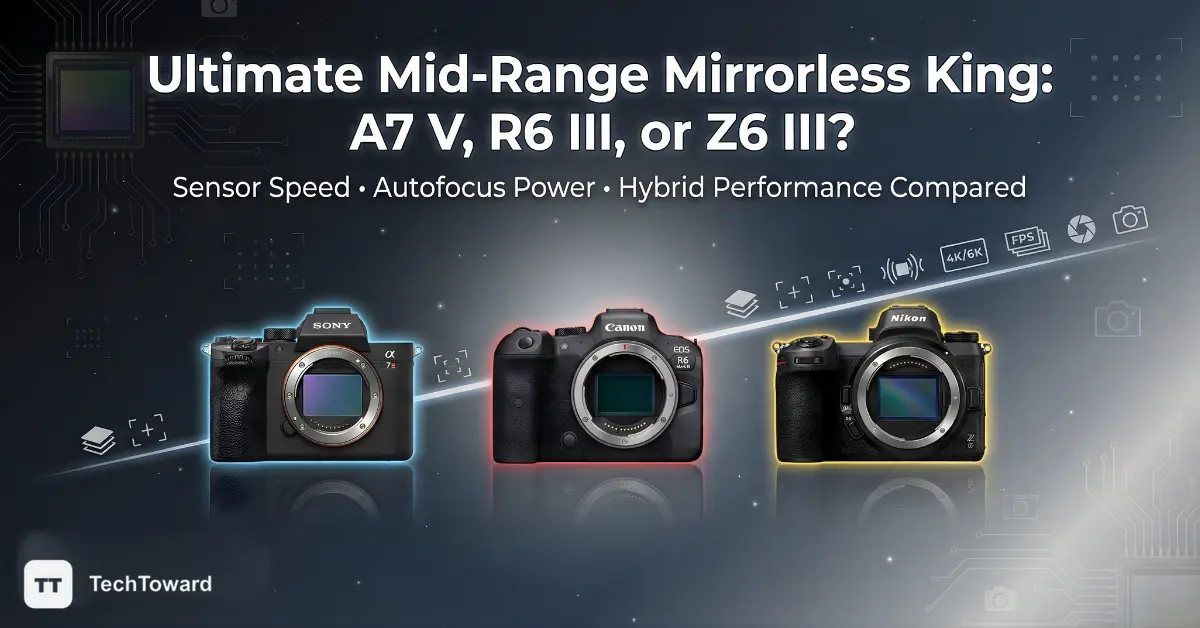
Ultimate Mid-Range Mirrorless King: A7 V, R6 III, or Z6 III? might sound like a simple camera-spec showdown — but beneath the surface lies a powerful truth: with the right mid-range mirrorless camera, you can unlock professional-level image quality, effortless video, and creative flexibility — often without spending as much as a full-blown flagship costs. The trick is knowing which one actually matches your vision.
In this guide, I compare Sony A7 V, Canon EOS R6 Mark III, and Nikon Z6 III — laying out their strengths, trade-offs, and which type of shooter each is best for. By the end, you’ll know exactly which mid-range mirrorless “king” deserves a spot on your camera shelf.
Why This Debate Hits Home
Imagine this scenario: you’re switching from a crop-sensor setup or older full-frame DSLR. You want something that feels professional. Weddings, travel, low-light portraits, short films, maybe a bit of wildlife — but you don’t want to spend $5,000+ for a flagship.
What you want is a hybrid workhorse: a camera that’s fast enough for moving subjects, detailed enough for portraits and landscapes, and video-capable enough for modern content.
That’s where mid-range mirrorless — and specifically these three cameras — come in.
Here’s what you’ll discover next:
- The technical “magic” behind each camera (sensor, stabilization, autofocus)
- Real-world strengths and trade-offs of each model
- Which camera aligns with different shooting styles (portraits, video, travel, action)
- My recommendation — and how to choose based on your own priorities
Why These Three Are the “Mid-Range Mirrorless Kings”
What Makes a Mid-Range Mirrorless Camera “King”
- Full-frame sensor (or equivalent) — for wide field of view, depth, and dynamic range
- Fast autofocus + reliable performance — so you don’t miss critical shots
- Hybrid readiness — able to handle both still photos and video
- Strong value — high-end-ish results at mid-range pricing
And importantly: flexibility. You don’t just get a “studio camera,” you get a versatile tool.
The A7 V, R6 III, and Z6 III each bring something unique to that balance.
Sensor & Speed Showdown: Why “Stacked / Partially Stacked / Read-out Speed” Matters
What is a “partially stacked” sensor — and why it changes the game
- A “stacked sensor” stacks processing circuits + memory directly on (or under) the sensor, allowing lightning-fast readout. High-end bodies use fully stacked sensors.
- A “partially stacked” sensor — like in the Z6 III (and now A7 V) — stacks only parts of the circuitry, giving a significant speed boost over traditional sensors, while controlling cost.
- Benefits: much faster readout → less rolling shutter, higher burst rates, usable electronic shutter for action/street/video.
- Trade-offs: some reduction in dynamic range or slightly noisier shadows (especially at high ISO) compared with non-stacked 14-bit sensors.
That matters because it affects how “real-world ready” the camera is — not just in the lab, but when you’re shooting a concert, street, sports, or fast-paced event.
How Each Camera Stacks Up — Strengths & Trade-Offs
Sony A7 V — The All-Rounder with Great Balance
Why it stands out:
- Uses a 33 MP partially stacked BSI sensor + new processing engine — giving excellent AF, readout speed, and dynamic range potential.
- Up to ~7.5-stop in-body image stabilization (IBIS) — very helpful handheld or in low light.
- 4-axis vari-angle rear screen — friendly for video creators, vlogging, diverse shooting angles.
- Blackout-free EVF at high refresh rates + many phase-detect AF points; good for tracking moving subjects.
- Strong lens ecosystem (Sony E-mount) — a big plus if you already have Sony glass.
Trade-offs:
- Video is good (4K up to 120fps in crop), but lacks built-in RAW video and some features that rivals offer.
- Slight compromise: although dynamic range is strong (Sony claims ~16 stops), some photographers note realistic performance varies depending on scene and exposure.
- Price is higher than simple entry-level — but you’re paying for a “goldilocks” hybrid.
✅ Best for: Portraits, landscapes, travel, casual video, hybrid creators who want a reliable, all-around full-frame without going overboard on video specs.
Canon EOS R6 Mark III — The Burst & Video Powerhouse
Why it stands out:
- 32.5 MP sensor; powerful imaging pipeline and Canon’s well-known color science.
- Extremely fast shooting: up to 40 fps with electronic shutter (12 fps mechanical), and a generous buffer for RAW / JPEG bursts — excellent for action, sports, or unpredictable moments.
- IBIS up to 8.5 stops, plus lens stabilization synergy — superb handheld potential.
- Video credentials: internal RAW video support (including high resolution/fps options), oversampled 4K up to high frame rates, 10-bit/12-bit support, and Canon’s picture profiles — cinematic features in a mid-range body.
- Dual card slots, full-size HDMI, real-time subject tracking (people, animals, vehicles) — ideal for professional workflows.
Trade-offs:
- The sensor is not stacked — meaning electronic shutter readout isn’t quite as “instant” as stacked chips; may have some rolling shutter limitations.
- In some advanced video modes (or high-ISO stills), dynamic range and shadow detail may be slightly behind cutting-edge stacked sensors.
- If you rarely shoot video, many of its video capabilities may feel like overkill — some users feel they’re “paying extra for features they won’t use.”
✅ Best for: Mixed workflows — photographers seeking high burst speed (sports, events), hybrid shooters who take advantage of video, or creators needing fast autofocus + handheld stability.
Nikon Z6 III — The Hybrid Workhorse for Speed and Versatility
Why it stands out:
- 24.5 MP partially stacked full-frame sensor + modern processor — enabling fast readout, clean electronic shutter, minimal rolling shutter, and quick burst/video performance.
- Burst: up to 20 fps RAW (electronic) or 14 fps mechanical; also supports pre-shoot burst (great for capturing elusive moments you didn’t anticipate).
- Video: internal 6K RAW, ProRes & N-RAW options, 4K up to 60/120 fps, slow motion 1080p/240fps — giving flexibility for content creators and filmmakers.
- EVF: bright, high resolution, blackout-free electronic shutter — important for confident shooting across situations.
- Dual card slots, robust build quality, and weather sealing — serious mid-range body ready for field work or travel shooting.
Trade-offs:
- Lower megapixel count (24.5 MP) — not ideal if you need large prints or heavy cropping flexibility.
- Slight hit in dynamic range & noise performance compared with 14-bit, non-stacked sensors — in demanding shadow/highlight scenarios (especially at high ISO) it may show.
- Lens ecosystem is growing but still smaller compared to some rivals — may require investment or adapters depending on lens needs.
✅ Best for: Hybrid shooters, videographers, travel photographers, event shooters, anyone who values speed, reliability, and versatility over sheer resolution.
Which Camera Fits Your Shooting Style — Quick Match Table
| Shooting Style / Priority | Recommended Camera |
| Portraits, landscapes, travel, hybrid photo + video | Sony A7 V — balanced, high-resolution, great AF & IBIS. |
| Sports, wildlife, fast action, bursts | Canon EOS R6 Mark III — fastest burst, strong subject tracking, rapid-fire performance. |
| Video-heavy workflows, hybrid content creation, documentary, events | Nikon Z6 III — excellent video flexibility, fast sensor readout, RAW video, robust build. |
| Mixed photography + occasional video, versatility, field work | Nikon Z6 III or Sony A7 V — choose based on need for speed (Z6 III) vs. resolution & lens ecosystem (A7 V). |
| Professional/travel vloggers, handheld shooting, low light enthusiasts | Canon EOS R6 Mark III or Sony A7 V — best IBIS and autofocus for dynamic shooting environments. |
Why Many Photographers Are Conflicted — It’s Not Just Specs
I’ve seen debates on forums where photographers switch between these cameras depending on the shoot. One common tension: stacked-sensor speed vs. dynamic range and pixel count.
For example, some users love the Z6 III’s responsiveness, especially in electronic shutter mode — especially when chasing unpredictable moments.
Yet others — especially those focusing on stills, landscapes, or portrait work — note that dynamic range and tonal gradation can suffer slightly compared to traditional 14-bit sensors.
Meanwhile, buyers of the R6 III sometimes question whether they really use all those video bells and whistles: some feel they’re “paying extra for features they’ll never use.”
What that shows is: the “best” mid-range mirrorless camera is often the one that fits how you shoot — not just what looks best on paper.
My Recommendation — Which Mid-Range Mirrorless King I’d Choose
If I were building a hybrid photography + video kit today — something versatile enough for travel, portraits, occasional action, and documentary work — I’d go with Nikon Z6 III.
Why? Because its partially stacked sensor gives a sweet spot of speed, flexibility, and reliability, and its RAW video + 6K internal capture make it future-proof for hybrid shooters.
If instead my focus is on portrait work, landscapes, or lens availability — and video is secondary — then Sony A7 V wins without a doubt.
If I need burst speed, fast subject tracking, and robust video features — especially for fast-moving subjects or dynamic handheld shooting — Canon EOS R6 Mark III is a superb choice.
FAQs — Real Questions Photographers Ask (and My Honest Answers)
Q: Which of these is best for low-light photography?
Short answer: All three perform well, but the A7 V and Z6 III tend to handle noise more gracefully due to their stabilization and sensor readout.
Z6 III’s modern sensor and fast readout help avoid rolling shutter in low light, while A7 V’s high-resolution sensor gives extra detail. R6 III is competent too, especially with stabilized lenses — but noise in deep shadows can creep up depending on ISO.
Q: If I mostly shoot video, which should I pick?
Go with Nikon Z6 III — its internal 6K RAW, flexible video formats, and excellent stabilization make it the most video-ready. Canon R6 Mark III is a close second with strong video features and Canon’s color science. Sony A7 V works well too, but its video features are more “hybrid-friendly” than “cinema-ready.”
Q: Is dynamic range or image quality noticeably worse with a partially stacked sensor?
Yes — on paper, partially stacked sensors trade a bit of dynamic range and low-light tonal gradation compared to traditional 14-bit non-stacked sensors.
But for most real-world shooting (portraits, events, travel) the difference is often negligible — especially with good exposure and RAW processing.
Q: Which has the best autofocus and subject tracking?
All are very good. A7 V and Z6 III benefit from modern AF technology and fast sensor readout. R6 III’s autofocus coverage and subject detection are strong, especially for people, animals, and vehicles.
For moving subjects, Z6 III and A7 V may have a slight edge thanks to sensor speed, while R6 III delivers reliable focus with Canon’s proven algorithms.
Q: If I’m new to full-frame mirrorless, does it matter which one I choose first?
Yes — think about your priorities. If you value flexibility and future-proofing, go for Z6 III. If you care about image quality and lens choice, A7 V is a great gateway. If you lean toward action, events, or handheld shooting — R6 III might give you the confidence to grow.
Final Thoughts — Your Move, Your Vision
I believe mid-range mirrorless cameras today are no longer “entry-level compromises.” With bodies like A7 V, R6 III, and Z6 III, you’re getting real versatility — serious resolution, powerful video, blazing autofocus — at a price and size that’s manageable.
There’s no one-size-fits-all “king.” But there is a right king for you. Which one you pick depends on what you shoot, how you shoot, and where you want your work to go.
So — don’t just chase specs. Think about your next shoot, your long-term creative goals, and how the camera will serve your vision. When you choose with intention, you don’t just buy a camera — you invest in your craft.
Now that you know what each of these mid-range mirrorless cameras really brings to the table, take a moment: write down what you value most (stills? video? speed? portability? lens options?) — then pick the camera that matches that list. You’ll thank yourself when the shutter clicks.