Summary
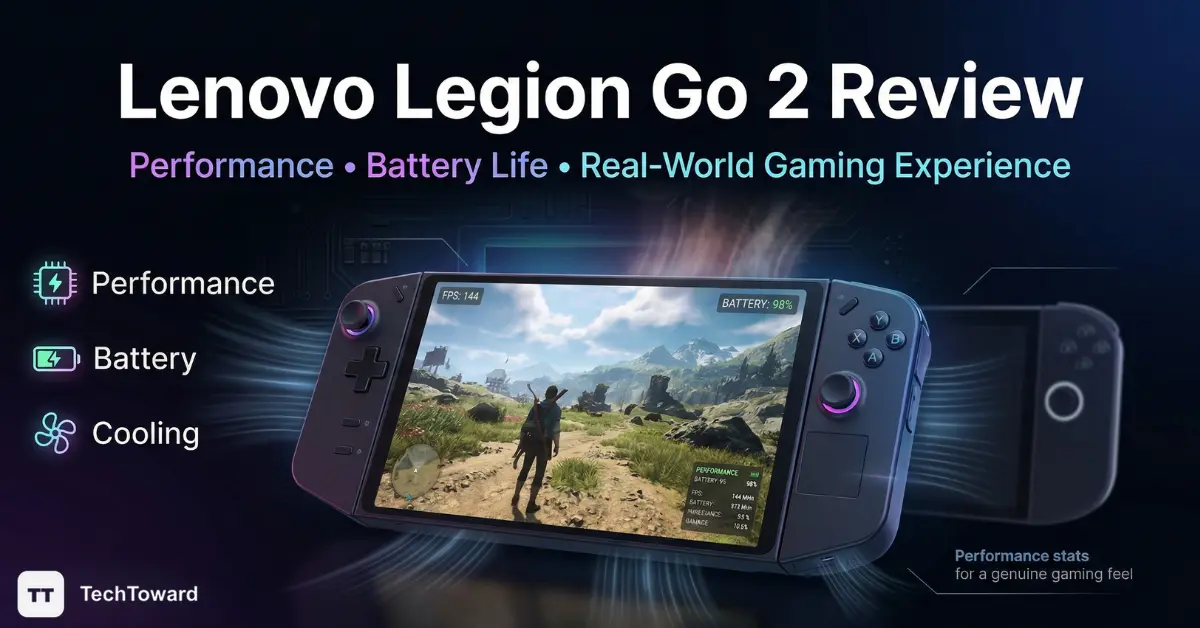
The Lenovo Legion Go 2 refines handheld PC gaming with stronger performance, smarter thermal control, and more practical battery behavior than its predecessor. It stands out as one of the most capable portable gaming systems in 2026, though its value depends heavily on how and where it is used. For players weighing an upgrade or comparing it to rivals, the decision ultimately comes down to performance priorities versus portability expectations.
Why Handheld Gaming Feels Different in 2026
Portable gaming PCs are no longer niche experiments—they are becoming primary gaming devices for a growing segment of players. What many comparisons still miss, however, is that raw specifications are no longer the main differentiator. The real shift is happening in efficiency, thermal balance, and real-world usability.
Devices like the Lenovo Legion Go 2 are not just competing on frame rates anymore. They are competing on how consistently they deliver performance without draining battery, overheating, or forcing compromises that break immersion.
That is where this device becomes interesting—not because it is the most powerful on paper, but because of how it tries to balance competing priorities.
Where Performance Actually Improves (and Where It Doesn’t)
The most noticeable upgrade comes from improved processing efficiency rather than just raw horsepower. The Legion Go 2 pushes higher and more stable frame rates in modern titles, especially in demanding AAA games where handheld PCs traditionally struggle.
In practical terms, this translates into:
- More consistent performance in open-world games
- Reduced frame drops during CPU-heavy scenes
- Better handling of background processes in Windows-based gaming
However, the improvement is not universal. The device still relies on smart power management to sustain performance. When pushed to maximum settings, it behaves similarly to other handheld gaming PCs—heat increases, and performance scaling becomes necessary.
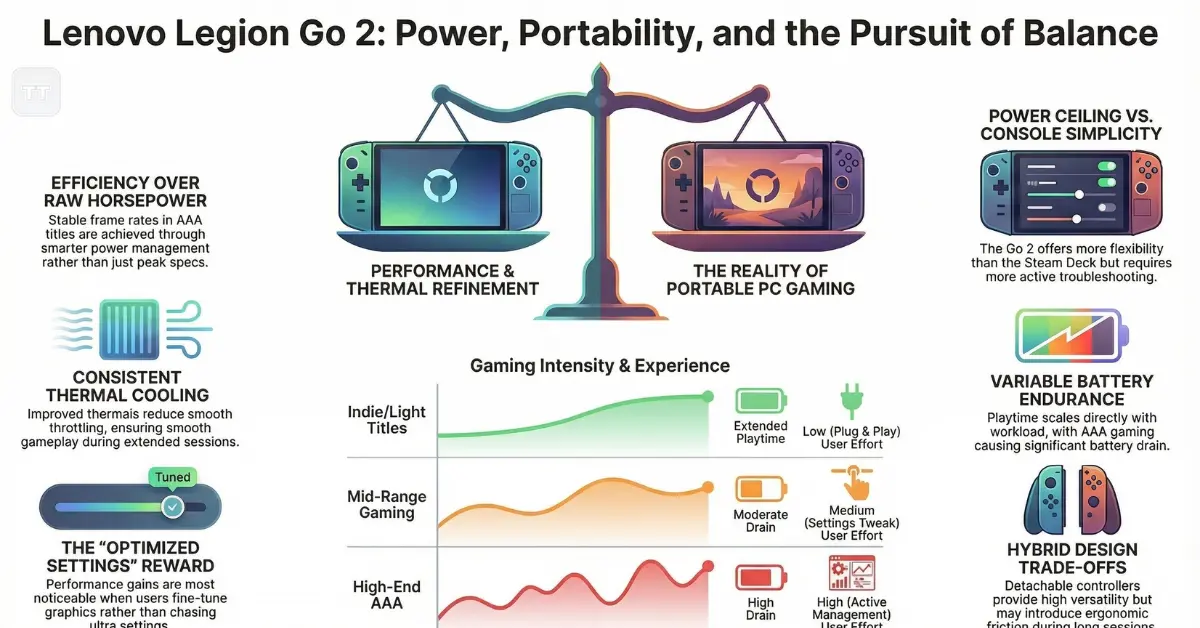
The overlooked detail is that performance gains are most noticeable at optimized settings, not at maximum ones. This changes how the device should be used. Instead of chasing ultra settings, the Legion Go 2 rewards users who fine-tune graphics and power profiles.
This subtle shift is what separates a good experience from a frustrating one.
The Hidden Role of Thermal Design in Real-World Gaming
Thermal design rarely gets enough attention, yet it directly shapes performance. The Legion Go 2 introduces more efficient cooling, which has a measurable impact on sustained gameplay.
Rather than boosting peak performance, the improved thermal system:
- Keeps performance stable over longer sessions
- Reduces sudden throttling
- Maintains more predictable fan behavior
This matters more than raw benchmarks suggest. Many handheld devices can hit high frame rates briefly, but consistency is what determines whether gameplay feels smooth.
The tradeoff, however, is subtle. Improved cooling often means slightly increased device size or fan noise under load. While not intrusive, it is noticeable during extended sessions in quiet environments.
Battery Life: The Real Limiting Factor
Battery life continues to define the handheld gaming experience more than any other factor. The Legion Go 2 improves efficiency, but expectations still need to be realistic.
In real-world use:
- Light gaming or indie titles can stretch battery life to several hours
- Mid-range gaming sits in a moderate range
- High-end AAA gaming significantly reduces playtime
The key insight is that battery performance scales directly with user behavior. Players who adjust resolution, refresh rate, and power modes can extend usage significantly.
A common misconception is expecting laptop-like endurance. Handheld PCs operate under tighter thermal and battery constraints, meaning battery optimization becomes part of the experience rather than an optional tweak.
For users who primarily game at home or near power sources, this limitation becomes less relevant. For travelers or commuters, it becomes the defining factor.
Comparing the Experience: Legion Go 2 vs Steam Deck
The comparison between the Legion Go 2 and the Steam Deck remains one of the most relevant in 2026. However, the difference is no longer just about power—it is about philosophy.
The Steam Deck prioritizes:
- Simplicity and console-like experience
- Optimized software integration
- Lower entry barrier for casual users
The Legion Go 2 focuses on:
- Higher performance ceiling
- Greater flexibility with Windows
- Broader compatibility with PC ecosystems
This leads to an important distinction:
The Steam Deck often feels more consistent, while the Legion Go 2 feels more capable but dependent on user control.
This difference influences who each device is best suited for. Players who prefer plug-and-play gaming may find the Steam Deck more approachable. Those who want deeper control and access to the full PC ecosystem will likely gravitate toward the Legion Go 2.
Display and Input: More Than Just Visual Quality
Display upgrades are not just about resolution or brightness—they shape usability. The Legion Go 2 delivers a sharper and more responsive screen, which enhances both gaming and general use.
What stands out is how the display contributes to:
- Improved readability in UI-heavy games
- Better immersion in visually rich titles
- More flexibility for productivity tasks
The detachable controller design continues to be a defining feature. While it adds versatility, it also introduces a tradeoff in ergonomics. Extended sessions may feel slightly less natural compared to fixed-controller designs.
This design choice reflects a broader trend: handheld PCs are evolving into hybrid devices, not just gaming tools.
The Overlooked Factor: Software Experience
Hardware improvements often dominate discussions, but software plays an equally important role. The Legion Go 2 runs on a full Windows environment, which offers flexibility but introduces complexity.
The advantages include:
- Access to multiple game launchers
- Compatibility with a wide range of PC software
- Customization options for performance tuning
The downside is that it requires active management. Updates, drivers, and occasional troubleshooting are part of the experience.
This creates a clear divide:
- Users comfortable with PC ecosystems will benefit greatly
- Those expecting console-like simplicity may encounter friction
This is not a flaw—it is a design tradeoff.
Who Should Actually Upgrade?
The decision to upgrade depends less on specifications and more on usage patterns.
An upgrade makes sense for:
- Users of first-generation handheld PCs seeking better stability
- Players who want higher performance in modern games
- Those comfortable optimizing settings for better efficiency
It may not be necessary for:
- Casual gamers satisfied with current performance levels
- Players prioritizing long battery life over power
- Users who prefer simple, console-like experiences
The critical insight is that the Legion Go 2 is not universally better—it is more specialized.
A Subtle Shift in What “Best” Means
Calling any device the “best handheld gaming PC in 2026” oversimplifies the reality. The category has matured to the point where different devices excel in different areas.
The Legion Go 2 stands out for:
- Performance flexibility
- Hardware innovation
- PC ecosystem integration
But it does not fully solve:
- Battery limitations
- Complexity of Windows-based gaming
- The balance between portability and power
This reframes the buying decision. Instead of asking which device is best overall, the better question is which device aligns with how gaming actually happens day-to-day.
Frequently Asked Questions
Is the Lenovo Legion Go 2 good for AAA gaming?
Yes, it handles AAA titles well, especially at optimized settings. Performance is strong, but achieving the best experience often requires adjusting graphics and power profiles.
How does battery life compare to other handheld PCs?
It is competitive but not revolutionary. Battery life varies significantly based on usage, with demanding games reducing playtime more quickly.
Is it better than the Steam Deck?
It depends on priorities. The Legion Go 2 offers more power and flexibility, while the Steam Deck provides a simpler, more consistent user experience.
Does it replace a gaming laptop?
Not entirely. It can handle many gaming scenarios, but limitations in sustained performance and battery life mean it complements rather than replaces a laptop.
Is it suitable for beginners?
It can be used by beginners, but it is better suited for users comfortable with PC settings and customization.
Final Verdict: A Device That Rewards the Right User
The Lenovo Legion Go 2 is not designed to appeal to everyone—and that is precisely why it stands out. It represents a more mature phase of handheld gaming, where flexibility and performance come with responsibility.
The most important takeaway is this: the experience improves significantly when the user understands how to work with the device, not just what it offers on paper.
For those willing to fine-tune settings and embrace the flexibility of a portable PC, it becomes one of the most compelling handheld gaming options available today. For others, simpler alternatives may still provide a more satisfying experience.
At this point, many users are not just choosing a device—they are choosing the kind of gaming experience they want to live with every day.